How to Find the Best Plastic Surgeon for Your Needs
Choosing a plastic surgeon is one of the most important decisions you’ll make when considering cosmetic or reconstructive surgery. The right surgeon combines technical skill, aesthetic judgment, safety protocols, and communication style that matches your needs. This guide walks you through the essential steps to identify, evaluate, and select a qualified plastic surgeon you can trust.
What You’ll Learn in This Guide
- Core qualifications every plastic surgeon should have
- Step-by-step evaluation process from research to final selection
- Red flags and warning signs to watch for
- Questions to ask during consultations
- How to verify credentials and review results
- Advanced considerations for complex procedures
- Resources for checking surgeon backgrounds
Understanding Plastic Surgery Credentials
Before diving into how to find the best plastic surgeon, it’s important to understand what qualifications matter. Plastic surgery is a specialized medical field requiring extensive training beyond medical school.
Board Certification Basics
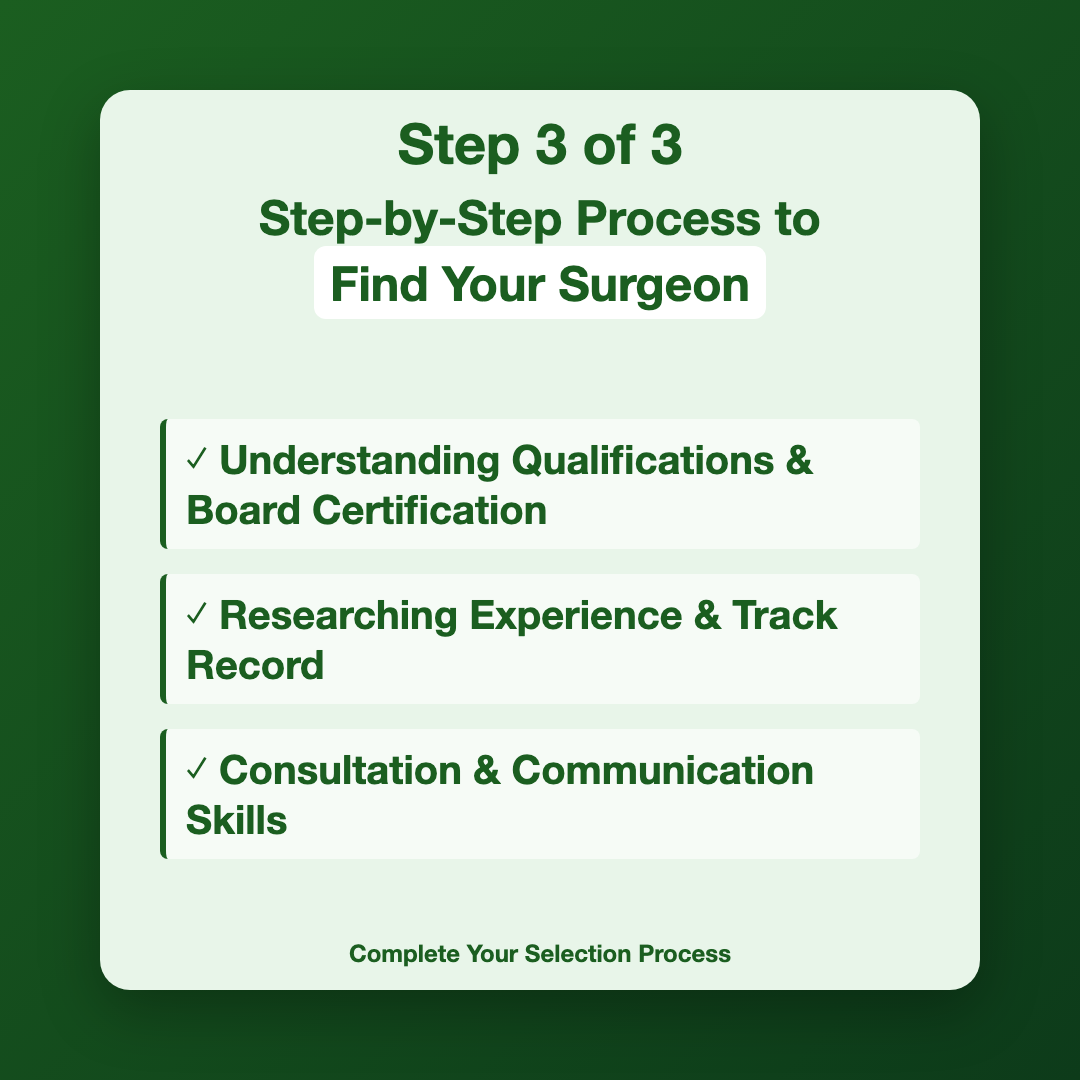
Board certification by the American Board of Plastic Surgery (ABPS) represents the gold standard in the United States. This certification requires completion of an accredited plastic surgery residency program (typically 5-7 years after medical school), passing comprehensive written and oral examinations, and maintaining ongoing education requirements.
Some physicians practice cosmetic procedures without being board-certified in plastic surgery. They may hold certifications in other specialties like dermatology, otolaryngology, or general surgery. While these doctors can be skilled, plastic surgery board certification specifically demonstrates training in the full range of cosmetic and reconstructive techniques.
Training and Experience
Beyond basic certification, consider whether a surgeon has completed fellowship training in your area of interest. For example, craniofacial fellowships focus on facial procedures, while hand surgery fellowships specialize in extremity reconstruction. This additional training often indicates deeper expertise in specific procedures.
Experience matters significantly. A surgeon who performs your desired procedure regularly will typically achieve more consistent results than one who does it occasionally. During consultations, ask how many times the surgeon has performed your specific procedure and request to see multiple examples of their work.
Step-by-Step Process to Find Your Surgeon
Step 1: Define Your Goals and Research Procedures
Start by clearly identifying what you want to achieve. Research your desired procedure thoroughly using reputable medical sources. Understanding the basics helps you ask informed questions and recognize when a surgeon’s recommendations align with established practices.
Consider whether you need cosmetic enhancement or reconstructive surgery following injury, illness, or congenital conditions. Some surgeons specialize more heavily in one area than the other.
Step 2: Compile a List of Potential Surgeons
Create an initial list of candidates through multiple sources:
- The American Society of Plastic Surgeons (ASPS) “Find a Plastic Surgeon” tool
- Referrals from your primary care physician or other trusted doctors
- Recommendations from friends or family who’ve had successful procedures
- Local medical centers known for plastic surgery excellence
- Professional organizations specific to your procedure (facial plastic surgery societies, breast surgery groups, etc.)
Aim for 3-5 surgeons to evaluate. This gives you meaningful comparison points without becoming overwhelming.
Step 3: Verify Credentials and Background
For each surgeon on your list, verify:
- Board certification: Check the American Board of Plastic Surgery website directly
- State medical license: Confirm active, unrestricted status through your state medical board
- Hospital privileges: Surgeons with privileges at accredited hospitals undergo peer review
- Malpractice history: Search state medical board databases for disciplinary actions or lawsuits
- Professional memberships: ASPS membership requires board certification and ethical standards adherence
This verification step eliminates unqualified practitioners before you invest time in consultations.
Step 4: Review Before-and-After Photos
Examine each surgeon’s photo gallery carefully. Look for patients with similar features, concerns, and goals to yours. High-quality surgeons typically show:
- Consistent, natural-looking results across multiple patients
- Clear before-and-after photos from similar angles and lighting
- Results that match your aesthetic preferences
- Honest representation including some challenging cases
Be cautious if photos look overly edited, show only perfect outcomes, or feature very different lighting and angles between before and after images. During consultations, ask to see additional photos beyond what’s displayed publicly, particularly for your specific procedure.
Step 5: Read Patient Reviews Thoughtfully
Online reviews provide valuable insights but require careful interpretation. Look across multiple platforms (RealSelf, Google, Healthgrades, Vitals) rather than relying on a single source.
Pay attention to:
- Detailed descriptions of the patient experience, not just star ratings
- How the surgeon and staff handled complications or concerns
- Consistency in comments about communication style and bedside manner
- Recent reviews (within the past 1-2 years) for current practice patterns
Some negative reviews are normal—no surgeon achieves perfect satisfaction with every patient. Look for patterns rather than isolated complaints, and consider whether negative reviews describe legitimate concerns or unrealistic expectations.
Step 6: Schedule Consultations
Narrow your list to 2-3 surgeons and schedule in-person consultations. Many surgeons charge consultation fees, though some apply this toward your procedure cost if you proceed.
Come prepared with:
- Your medical history, including current medications and past surgeries
- Reference photos showing your desired outcome
- A written list of questions
- Realistic budget and timeline expectations
During the consultation, a qualified surgeon should:
- Listen carefully to your goals and concerns
- Perform a thorough physical examination
- Explain what can realistically be achieved
- Discuss alternative approaches if applicable
- Review risks, benefits, and recovery expectations
- Show relevant before-and-after photos
- Provide detailed cost estimates
- Answer all questions without rushing
Pay attention to how you feel during the interaction. The best plastic surgeon for you should make you feel heard, respected, and confident—not pressured or dismissed.
Step 7: Evaluate the Facility and Team
Where your surgery takes place matters significantly for safety. Ask about:
- Accreditation: The facility should be accredited by AAAASF, AAAHC, JCAHO, or be a licensed hospital
- Anesthesia providers: Board-certified anesthesiologists or certified nurse anesthetists should administer anesthesia
- Emergency protocols: The facility should have emergency equipment and established transfer agreements with nearby hospitals
- Staff qualifications: Nurses and surgical assistants should have appropriate credentials and experience
If possible, tour the surgical facility before committing. Clean, well-organized, professional environments with modern equipment indicate attention to quality and safety.
Red Flags and Warning Signs
Certain warning signs should prompt you to look elsewhere:
- Lack of proper certification: Not being board-certified by ABPS for plastic surgery procedures
- High-pressure sales tactics: Pushing you to commit immediately or offering steep “today only” discounts
- Unrealistic promises: Guaranteeing perfect results or claiming a procedure is risk-free
- Poor communication: Dismissing your concerns, rushing through explanations, or making you feel foolish for asking questions
- Unclear pricing: Refusing to provide written cost estimates or being vague about what’s included
- Limited or no hospital privileges: While office-based surgery can be safe, hospital privileges indicate peer oversight
- Performing procedures outside their specialty: A surgeon certified in another field offering extensive plastic surgery services
- Multiple negative reviews mentioning similar problems: Patterns of poor outcomes, complications, or unprofessional behavior
- Unaccredited surgical facility: Operating in a space without proper accreditation or safety standards
Trust your instincts. If something feels wrong or too good to be true, it probably is. Taking extra time to find the right surgeon is far better than rushing into a decision you’ll regret.
Common Mistakes to Avoid
Choosing Based Solely on Price
Cost is understandably a factor, but selecting a surgeon primarily because they’re the cheapest option often leads to disappointment or worse. Experienced, highly qualified surgeons typically charge more because of their expertise, safety standards, and results. Extremely low prices may indicate corners being cut on facility quality, anesthesia safety, or surgeon experience.
That said, higher prices don’t automatically mean better results. Evaluate the complete package—qualifications, experience, facility quality, and your comfort level—rather than price alone.
Skipping the Consultation
Some people try to save consultation fees by committing without meeting the surgeon in person. This is risky. The consultation is your opportunity to assess communication style, ask specific questions about your case, and ensure you feel comfortable with this person performing your surgery.
Ignoring Gut Feelings
If you feel rushed, dismissed, or uncomfortable during a consultation, don’t ignore those feelings. The surgeon-patient relationship requires trust and clear communication. Even a highly qualified surgeon isn’t the right choice if you don’t feel confident in their care.
Failing to Verify Credentials
Don’t rely solely on what a surgeon’s website claims. Independently verify board certification, licenses, and facility accreditation through official sources. Unfortunately, some practitioners misrepresent their qualifications.
Not Asking About Revision Rates
All surgeons occasionally need to perform revisions, but excessively high revision rates may indicate inconsistent results. Ask what percentage of patients require revision surgery and what the surgeon’s policy is regarding revision costs.
Advanced Considerations for Complex Cases
Revision and Corrective Surgery
If you’re seeking revision surgery to correct a previous procedure, finding the right surgeon becomes even more critical. Look for surgeons who:
- Have specific experience with revision cases in your area of concern
- Show before-and-after photos of revision work, not just primary procedures
- Take time to understand what went wrong previously and explain their corrective approach
- Have a reputation for handling complex cases
Revision surgery is typically more challenging than primary procedures, so experience matters tremendously.
Multiple Procedures or Full-Body Transformations
If you’re considering multiple procedures (such as a “mommy makeover” combining several operations), ensure your surgeon:
- Has extensive experience safely combining procedures
- Discusses realistic timelines—some procedures are better staged than combined
- Has appropriate facility resources for longer, more complex surgeries
- Clearly explains increased risks when combining procedures
Medical Complexity
If you have significant medical conditions (diabetes, heart disease, autoimmune disorders, etc.), you need a surgeon experienced in managing higher-risk patients. Ask about:
- Their experience with patients who have your specific condition
- How they coordinate with your other physicians
- Additional precautions or monitoring they implement
- Whether they have in-house or readily available medical support
Helpful Resources and Tools
Credential Verification Websites
- American Board of Plastic Surgery: Verify board certification status
- American Society of Plastic Surgeons: Find member surgeons and access educational resources
- State medical boards: Check license status and disciplinary history
- Federation of State Medical Boards: Search across multiple states
Educational Resources
- ASPS patient education pages: Detailed procedure information from the professional society
- RealSelf: Patient reviews, Q&A with surgeons, and procedure information (use critically—it’s marketing-driven)
- PubMed: Access medical research about procedures and outcomes
Facility Accreditation Organizations
- AAAASF (American Association for Accreditation of Ambulatory Surgery Facilities)
- AAAHC (Accreditation Association for Ambulatory Health Care)
- The Joint Commission (JCAHO)
Your Surgeon Selection Checklist
Use this checklist to ensure you’ve thoroughly evaluated each candidate:
- ☐ Board certified by the American Board of Plastic Surgery
- ☐ Active, unrestricted state medical license verified
- ☐ Hospital privileges at an accredited facility
- ☐ No concerning disciplinary actions or malpractice patterns
- ☐ Significant experience with your specific procedure
- ☐ Before-and-after photos match your aesthetic goals
- ☐ Positive overall patient review patterns
- ☐ Comfortable, professional consultation experience
- ☐ Clear communication about risks, benefits, and realistic outcomes
- ☐ Accredited surgical facility with qualified staff
- ☐ Board-certified anesthesia provider
- ☐ Transparent pricing with written estimates
- ☐ Revision policy clearly explained
- ☐ Your questions answered thoroughly without pressure
- ☐ You feel confident and comfortable with this surgeon
Frequently Asked Questions
How many consultations should I schedule?
Most people benefit from consulting with 2-3 surgeons. This provides meaningful comparison without becoming overwhelming. If none of your initial consultations feel right, continue searching rather than settling.
Is it okay to travel to another city for a highly regarded surgeon?
Traveling for surgery can be appropriate, especially for complex or revision procedures. However, consider the logistics of follow-up care. You’ll need multiple post-operative appointments, and complications requiring in-person evaluation can occur. Ensure you can return for follow-up visits or that the surgeon has arrangements with local physicians for post-operative care.
Should I choose a surgeon who specializes only in one procedure?
Surgeons who focus heavily on specific procedures (like rhinoplasty specialists or breast reconstruction experts) often develop exceptional skill in that area. However, excellent plastic surgeons can be highly skilled across multiple procedures. What matters most is their specific experience with your desired procedure, not whether they exclusively perform that one operation.
How important are online reviews?
Reviews provide useful insights into patient experiences, but they shouldn’t be your only consideration. Some excellent surgeons have fewer online reviews simply because their patients are more private. Conversely, some practices actively solicit positive reviews. Use reviews as one data point alongside credentials, consultations, and your personal impressions.
What if I can’t afford the surgeon I really want?
Never compromise on safety and qualifications to save money. If cost is prohibitive, consider:
- Asking about payment plans or medical financing options
- Saving longer to afford the surgeon you trust
- Looking for qualified surgeons at academic medical centers, which sometimes offer lower prices
- Reconsidering whether the procedure is necessary right now
What you shouldn’t do is choose an unqualified practitioner or travel abroad to unregulated facilities purely for cost savings.
Can I see the surgeon’s complication rates?
Most surgeons don’t publicly publish complication rates, but you can ask during consultations. Recognize that surgeons who take on more complex cases or revisions may have higher complication rates simply because they’re addressing more difficult situations. Ask how they handle complications and what their revision rate is for your specific procedure.
How do I know if a surgeon’s aesthetic style matches mine?
Review their before-and-after gallery carefully. Do their results look natural or more dramatic? Do they seem to create a consistent “look” across patients, or do results vary based on individual features? During consultation, bring reference photos of results you like and ask if the surgeon can achieve similar outcomes given your anatomy.
What questions should I definitely ask during consultation?
Essential questions include:
- How many times have you performed this specific procedure?
- What approach do you recommend for my case and why?
- What are the most common complications with this procedure?
- How do you handle complications if they occur?
- What will my recovery timeline realistically look like?
- What results can I reasonably expect given my anatomy?
- Where will the surgery be performed and is the facility accredited?
- Who will administer anesthesia and what are their qualifications?
- What’s included in the quoted price?
- What is your revision policy?
Conclusion
Finding the best plastic surgeon requires thorough research, careful evaluation, and honest self-reflection about your goals and comfort level. While the process takes time and effort, choosing the right surgeon significantly impacts your safety, results, and overall satisfaction.
Start with board certification and proper credentials as non-negotiable baseline requirements. Verify qualifications independently, review multiple examples of the surgeon’s work, and schedule consultations with your top candidates. Pay attention not just to technical qualifications but also to communication style, facility quality, and how you feel during interactions.
Remember that the “best” surgeon isn’t necessarily the most expensive, most famous, or most heavily advertised. The best plastic surgeon for you is one who combines proper qualifications, relevant experience, aesthetic judgment that matches your goals, and a communication style that makes you feel confident and cared for.
Trust the process, trust your research, and trust your instincts. When you find the right surgeon, you’ll know—and that confidence will serve you well throughout your surgical journey.
⚠️ Medical Disclaimer: This article is for informational purposes only and does not constitute medical advice. Plastic surgery carries risks that vary based on the specific procedure, your health status, and other factors. Always consult with qualified, board-certified plastic surgeons and other appropriate healthcare providers to discuss your individual situation, understand risks and benefits, and make informed decisions about your care.
📚 References
The official and high-authority sources below can help readers verify the context safely.