Breast Augmentation Recovery Time: What Each Stage Feels Like
Breast augmentation recovery time is often described as a few days of rest, a few weeks of gradual return to normal activity, and several months before the final look settles, though the exact range depends on the person and the surgical plan. Your body is doing different work at each point, which is why the first week feels nothing like the third month. This article lays out the general picture by stage, what people commonly ask about, and where individual differences tend to show up.
One point up front: nobody can give you a personal schedule except the surgeon who knows your procedure, implant placement, and health history. Think of what follows as a map of what is commonly described, not a set of instructions.
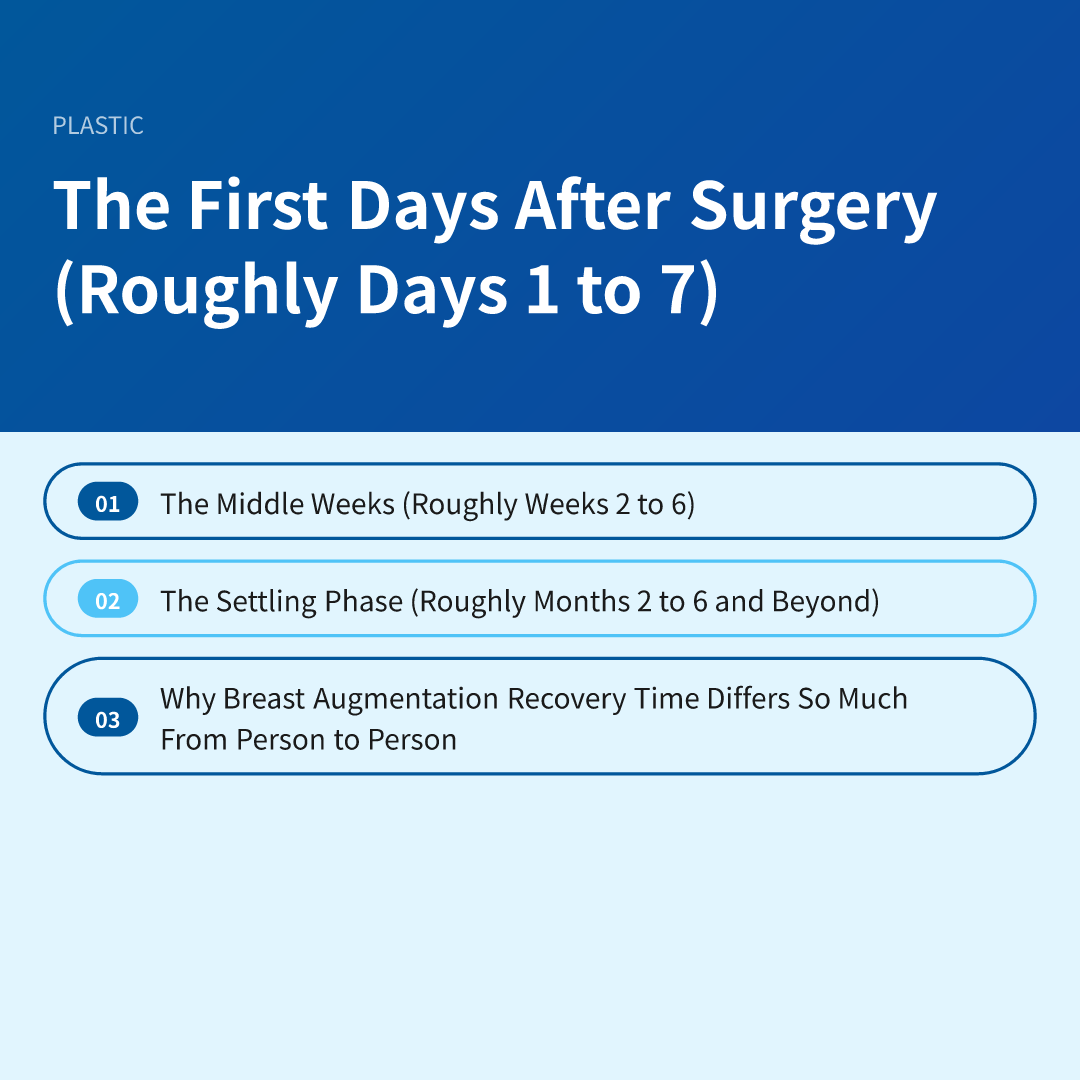
The First Days After Surgery (Roughly Days 1 to 7)
What is happening in your body
Right after the operation, the chest tissue is adjusting to a new implant and to the surgery itself. Soreness, tightness, swelling, and a feeling of pressure are commonly described, and many people say the tightness feels more like a heavy, stretched sensation than sharp pain. Fatigue is also common, partly from anesthesia and partly from the body’s general healing effort.
Bruising can appear on the chest and sometimes spreads downward. The breasts may sit high or look firm and uneven at first. That early appearance is usually not the final result, and surgeons generally explain this before the procedure.
What people commonly do in this stage
- Rest, with help arranged at home for lifting, meals, and daily tasks.
- Walk gently around the house, which surgeons often mention as a way to support circulation.
- Wear whatever support garment the surgical team provides, following their guidance.
- Keep in touch with the clinic about pain control, since medication choices and amounts are set by the prescribing clinician or pharmacist.
What people are usually told to avoid
- Lifting heavy objects or reaching overhead repeatedly.
- Driving while on prescription pain medication or while movement feels restricted.
- Skipping follow-up visits, since early checks help the surgical team see how healing is going.
- Making judgments about the final shape, because swelling distorts the early look.
Some symptoms deserve a prompt call to the surgical team or urgent care rather than waiting it out. These include sudden one-sided swelling, fever, spreading redness, worsening pain, drainage with a bad smell, chest pain, or trouble breathing. The American Society of Plastic Surgeons provides patient-facing information on breast augmentation and recovery at plasticsurgery.org, which is a reasonable place to read general background before your consultation.
The Middle Weeks (Roughly Weeks 2 to 6)
What is happening in your body
By this stage, the sharpest soreness usually eases and energy tends to return gradually. Swelling does not vanish overnight, though. It typically fades in a patchy way, so one side may look fuller than the other for a while. Skin sensation can feel odd, with tingling, numbness, or sensitivity around the incisions and nipples. Many people find this unsettling, yet changes in sensation are a commonly discussed part of the process, and how long they last varies.
The implants may also begin to settle lower, often described as “dropping and fluffing.” Breasts that looked high and tight early on commonly start to look more natural in shape during this window, although it is a gradual shift rather than a single moment.
What people commonly do in this stage
- Return to desk-style work when the surgeon clears it, which for many people is earlier than returning to physical jobs.
- Take longer walks and resume light daily routines at a comfortable pace.
- Follow the clinic’s guidance about scar care, massage, and supportive bras. Whether massage is recommended at all depends on the surgeon and the implant type, so ask rather than assume.
- Attend scheduled follow-ups and mention anything that feels off.
What people are usually told to avoid
- Returning to strenuous upper-body workouts before the surgeon says it is fine.
- Sleeping or stretching in ways the surgical team has asked you to avoid.
- Sun exposure on healing incisions, since new scars can be sensitive.
- Comparing your progress to someone else’s, which tends to add stress without adding information.
A quick, honest note: this is the stage where many people feel “almost normal” and push too hard. Feeling better is not the same as tissue being fully ready. Clearance for exercise and lifting is a decision for your surgeon, not a feeling.
The Settling Phase (Roughly Months 2 to 6 and Beyond)
What is happening in your body
Later on, residual swelling continues to reduce and the breast tissue and implant pocket keep adjusting. Scars commonly go through their own changes, often starting out firmer or more noticeable and softening or fading over a long period. Many people report that the look they see at a few months differs from the look at the earliest checks, and surgeons generally describe the final appearance as something that develops over time rather than arriving on a fixed date.
Sensation often continues to shift. Some people notice it returning gradually, while others find some changes persist. Whether and how completely it recovers is not something anyone can promise in advance.
What people commonly do in this stage
- Gradually return to fuller exercise routines once the surgeon approves, often building up slowly.
- Keep regular follow-up appointments, including any long-term monitoring the surgeon recommends for implants.
- Talk with the surgeon about scar care options if scars are a concern.
- Ask when it makes sense to go bra shopping for a long-term fit, since shape keeps changing for a while.
What people are usually told to avoid
- Ignoring new changes, such as a breast that becomes noticeably firmer, changes shape suddenly, or becomes painful. These are worth reporting to the surgical team.
- Assuming that symptoms are “just part of healing” without checking, especially if they are getting worse instead of better.
- Skipping imaging or screening recommendations that your clinician has discussed.
The U.S. Food and Drug Administration publishes general information for people considering or living with breast implants, including long-term considerations, at fda.gov. It is worth reading before surgery, since it covers topics a consultation may not have time to explore in depth.
Why Breast Augmentation Recovery Time Differs So Much From Person to Person
Two people can have the same operation and recover quite differently. Several factors are commonly discussed, and most of them are worth raising at the consultation rather than discovering afterward.
- Implant placement and surgical approach. Placement above or below the chest muscle is often discussed as affecting how sore the early days feel and how the implant settles. Your surgeon can explain how this applies to your plan.
- Implant size and body frame. Larger implants relative to your tissue may mean more stretching and a different early experience.
- Whether the surgery is combined with other procedures. A breast lift or other work at the same time can change what recovery involves.
- Your job and home life. A desk job and a physically demanding one, or having small children to lift, change how practical it is to rest.
- Overall health and habits. Smoking and nicotine use, certain medical conditions, and some medications are commonly flagged by surgeons as relevant to healing. Ask your surgical team what applies to you.
- Your body’s own healing pattern. Some people swell longer, bruise more, or scar differently for reasons that are not fully predictable.
If healing feels slower than expected: a sensible order of checks
Slow progress is frustrating, and it is easy to spiral. A calmer way to think about it is to work through questions in order, starting with the simplest.
- Look for warning signs first. Fever, spreading redness, sudden swelling on one side, worsening pain, unusual drainage, chest pain, or breathing difficulty call for prompt contact with the surgical team or emergency care. Do not wait for the next scheduled visit.
- Compare against what you were told. Reread your discharge papers and notes from the consultation. Some things that feel alarming, such as uneven swelling or high-sitting implants early on, are often described as part of the expected pattern.
- Consider your activity level. If you have been doing more than the surgeon cleared, discuss it honestly with the clinic. They would rather know than guess.
- Call the surgical office with specifics. Note when symptoms began, whether they are changing, and which side is affected. Photos taken in the same lighting can help the team judge change over time.
- Ask about other contributors. Medications, nicotine use, sleep, nutrition, and stress can all play a role in how you feel, and your clinician or pharmacist can help sort out which matter for you.
- Seek a second opinion if you are not getting answers. A different qualified professional can review your situation if you feel unheard, particularly when symptoms persist.
In the end, breast augmentation recovery time is better understood as a series of phases than a single deadline. Your surgeon’s guidance, based on your own body and procedure, should outweigh any general timeline you read online, this one included.
Disclaimer: This article is for informational purposes only and is not a substitute for professional medical advice, diagnosis, or treatment. Please consult a licensed professional for personal health decisions.
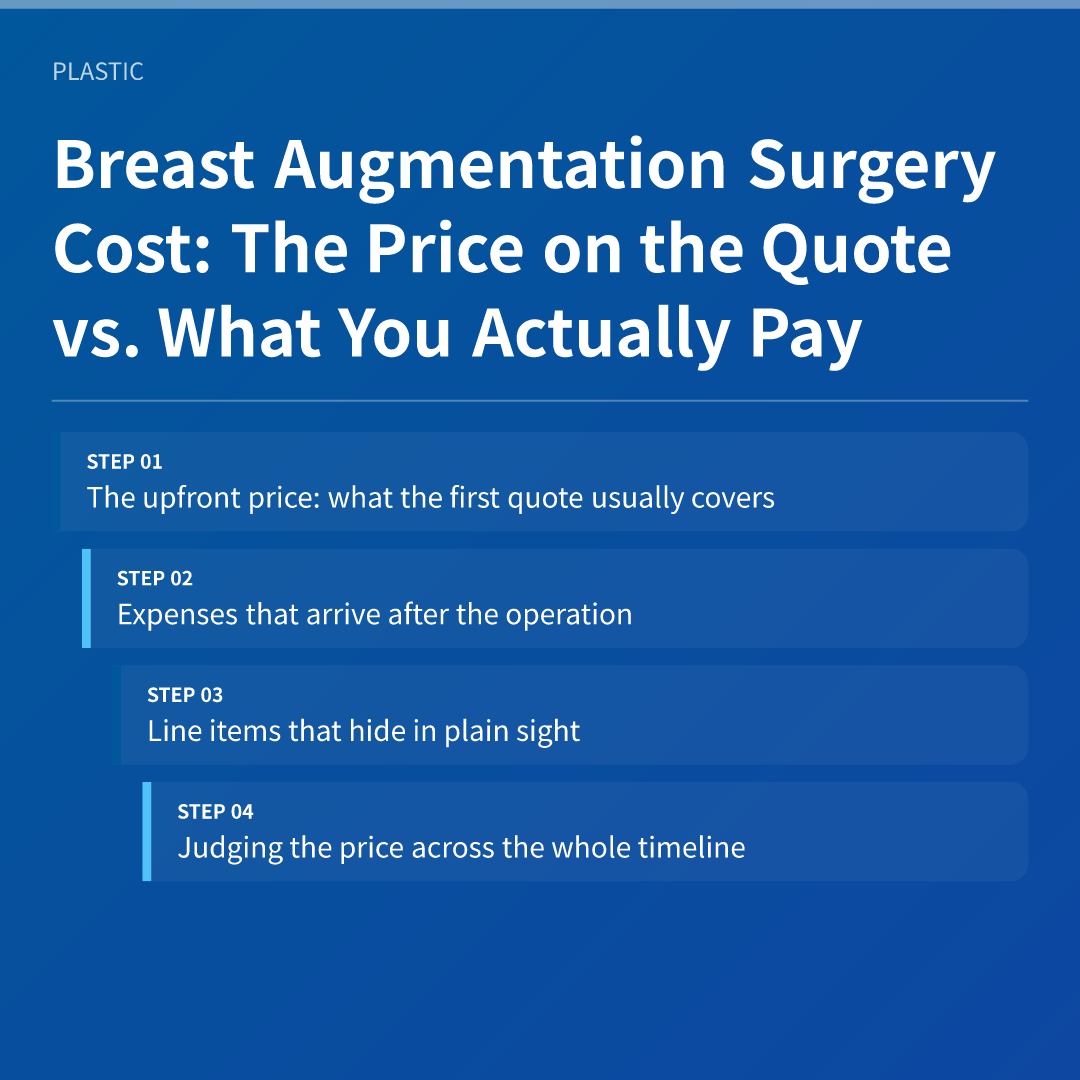
Related reading: Breast Augmentation Surgery Cost: The Price on the Quote vs. What You Actually Pay