Minoxidil Expectations Timeline: What to Expect Month by Month
Starting minoxidil feels like planting seeds—you know something is happening beneath the surface, but visible results take patience. Many people abandon treatment too early because they don’t understand the natural hair growth cycle or mistake normal shedding for failure. This guide walks you through the realistic minoxidil expectations timeline, month by month, so you know exactly what’s normal, when to worry, and how to track meaningful progress.
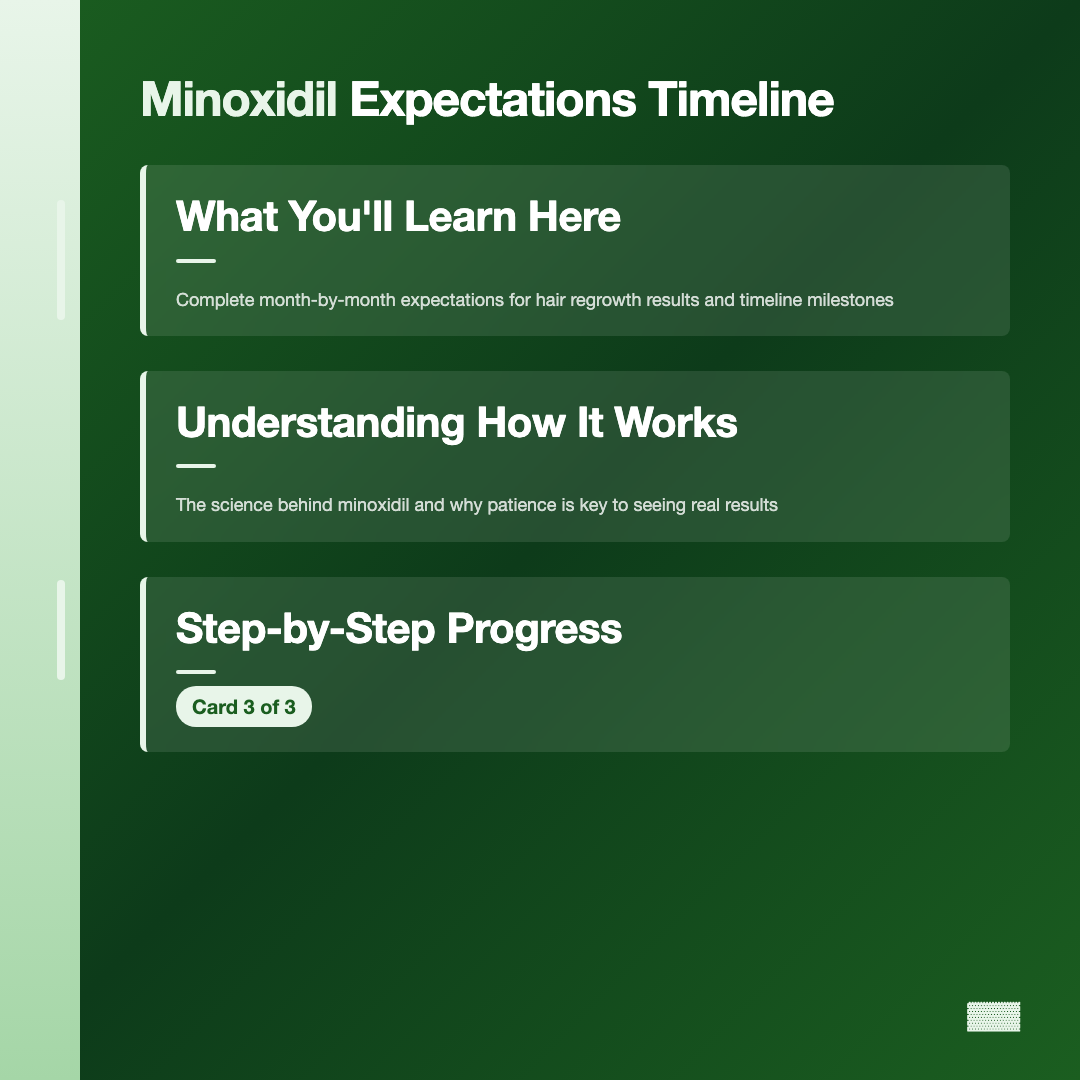
What You’ll Learn in This Guide
- How minoxidil works with your hair growth cycle
- The initial shedding phase and why it happens
- Month-by-month changes from week 1 to 12 months
- How to document progress objectively
- Common mistakes that sabotage results
- When to adjust expectations or seek professional input
- Advanced strategies for maximizing response
Understanding How Minoxidil Works
Minoxidil is a topical vasodilator originally developed for blood pressure. Applied to the scalp, it widens blood vessels around hair follicles, improving nutrient delivery and extending the anagen (growth) phase of the hair cycle. It doesn’t work instantly because hair grows in cycles—each follicle goes through growth, transition, rest, and shedding phases that last months.
The typical hair cycle includes anagen (2-7 years of growth), catagen (2-3 weeks of transition), telogen (3 months of rest), and exogen (shedding). Minoxidil pushes more follicles into anagen and shortens telogen, but this transition takes time. Understanding this cycle explains why you won’t see results overnight and why shedding often occurs first.
Response varies significantly. Studies show roughly 40-60% of users experience moderate to dense regrowth, while others see stabilization (halting further loss) rather than dramatic new growth. Genetics, the extent of miniaturization, consistency of use, and underlying causes of hair loss all influence outcomes.
Step-by-Step: Your Minoxidil Timeline
Step 1: Weeks 1-2 (Application Adjustment)
During the first two weeks, your scalp adjusts to the product. You may notice mild itching, dryness, or flaking—common reactions as your skin adapts to the alcohol-based solution or foam vehicle. Hair shedding is usually minimal at this stage.
Focus on establishing a consistent routine: apply the recommended dose (1 mL twice daily for solution, or a half-capful of foam) to a dry scalp, and avoid washing your hair for at least four hours afterward. Take baseline photos in consistent lighting from multiple angles—front, top, crown, and temples.
Step 2: Weeks 2-8 (Initial Shedding Phase)
This is the most psychologically challenging period. Many users experience increased hair shedding, sometimes dramatically. You might lose 50-100+ hairs daily, far more than your pre-treatment baseline. This shedding is actually a sign minoxidil is working—it’s pushing weak, miniaturized hairs in telogen out to make room for stronger anagen hairs.
The shed typically peaks around weeks 4-6 and tapers off by week 8-10. Not everyone experiences noticeable shedding, but if you do, resist the urge to stop. This phase is temporary. The hairs you lose are ones that would have fallen out anyway; minoxidil is simply accelerating the cycle to restart growth sooner.
Step 3: Months 2-3 (Early Regrowth Signals)
Shedding slows, and you may notice fine, light-colored vellus hairs emerging along the hairline or thinning areas. These “baby hairs” are often short and lack pigment initially. Your scalp might feel slightly different—some describe a tingling or “active” sensation as follicles reawaken.
Visible improvement is still minimal for most people. Photos may show little change, which is normal. The regrowth happening now is in early stages—hairs are growing but haven’t reached visible length or thickness yet. Patience is critical here; stopping now means losing all the progress your follicles are making beneath the surface.
Step 4: Months 3-4 (Visible Vellus Hair)
By month three, vellus hairs become more apparent. They’re still fine and may look like peach fuzz, but coverage is increasing. Some users notice their scalp looks less shiny or exposed in certain lighting. Terminal hairs (thicker, pigmented hairs) begin to emerge, though they’re shorter than surrounding hair.
This is when comparing photos becomes useful. Look for changes in the width of your part, the density of hair in previously sparse zones, and the presence of new short hairs. Progress is incremental—don’t expect a full head of hair yet, but small gains are accumulating.
Step 5: Months 4-6 (Noticeable Density Improvement)
The four-to-six-month window is where most users see clear, measurable improvement. Terminal hairs thicken and lengthen, filling in gaps. The overall density improves enough that friends or family might comment. Your hair may feel fuller when you run your fingers through it.
This phase is also when non-responders become apparent. If you see zero change by month six—no reduction in shedding, no vellus hair, no thickening—you may be a non-responder. Roughly 20-30% of users don’t respond significantly to minoxidil, often due to genetic factors or the type of hair loss. Consult a dermatologist or trichologist if you’re in this category; other treatments like finasteride (for men) or spironolactone (for women) might be more effective.
Step 6: Months 6-12 (Maximum Thickness and Stabilization)
Between six and twelve months, regrowth continues but at a slower, steadier pace. Most users reach their peak response by month 12. Terminal hairs mature fully, and the overall appearance stabilizes. Some areas may fill in completely, while others show partial improvement—this is normal and reflects the variable response of different follicles.
This is the time to assess whether results meet your expectations. If you’ve achieved noticeable improvement, continuing minoxidil maintains those gains. Stopping will cause regrown hair to shed within 3-6 months, as minoxidil’s effects are not permanent without ongoing use.
Step 7: Beyond 12 Months (Maintenance and Long-Term Use)
After one year, the goal shifts to maintenance. Continue applying minoxidil as directed—skipping doses or reducing frequency can lead to gradual thinning as follicles revert to their pre-treatment state. Some users see continued slow improvement into year two, but major changes are rare after 12 months.
Long-term use is generally safe for most people, though scalp irritation or unwanted facial hair (more common in women) may develop. If side effects become bothersome, discuss alternatives with a healthcare provider. Combining minoxidil with other treatments (like microneedling or low-level light therapy) can sometimes enhance results.
Common Mistakes and How to Avoid Them
Stopping during the shedding phase: This is the number one mistake. Shedding is a normal, expected part of the process. Quitting during weeks 2-8 wastes the progress your follicles are making. If shedding is severe or lasts beyond 10 weeks, consult a professional, but don’t stop on your own.
Inconsistent application: Minoxidil works only when used consistently. Skipping days, applying too little, or using it sporadically reduces effectiveness. Set reminders, integrate it into your morning and evening routines, and treat it like brushing your teeth—non-negotiable.
Expecting instant results: Hair grows slowly. Expecting visible change in weeks 2-4 sets you up for disappointment. Realistic expectations are crucial: minor improvements by month 3-4, noticeable gains by month 6, and peak results by month 12.
Poor photo documentation: Memory is unreliable for tracking gradual change. Without consistent photos (same lighting, angle, hair style, and time of day), you can’t objectively assess progress. Take photos monthly, and store them in a dedicated folder for easy comparison.
Using too much product: More minoxidil doesn’t mean faster results. Using more than the recommended dose increases the risk of side effects (scalp irritation, unwanted hair growth on the face or hands) without improving efficacy. Stick to 1 mL twice daily or the foam equivalent.
Ignoring underlying causes: Minoxidil treats symptoms, not causes. If your hair loss is due to thyroid issues, nutritional deficiencies, autoimmune conditions, or medications, minoxidil alone won’t fully resolve the problem. Address root causes with a healthcare provider for the best outcome.
Advanced Strategies for Better Results
Combine with microneedling: Some studies suggest microneedling (using a derma roller or pen to create tiny scalp injuries) enhances minoxidil absorption and stimulates growth factors. A common protocol is 1.5 mm needling once every 1-2 weeks, avoiding minoxidil application for 24 hours post-needling. This is more advanced and carries risks (infection, scarring if done incorrectly), so research thoroughly or consult a professional.
Optimize your scalp environment: A healthy scalp supports better results. Use a gentle, sulfate-free shampoo, avoid harsh styling products, and manage conditions like seborrheic dermatitis or dandruff that can interfere with absorption. Some users find ketoconazole shampoo (1-2 times weekly) helpful for scalp health and mild anti-androgenic effects.
Track additional metrics: Beyond photos, measure the width of your part with a ruler, count hairs in a defined area (e.g., a 1 cm square), or use a magnifying camera to assess hair diameter. Objective data helps you see progress that’s hard to spot in the mirror.
Consider combination therapy: For androgenetic alopecia (pattern hair loss), combining minoxidil with finasteride (men) or spironolactone (women) often yields better results than either alone. These medications address the hormonal component of hair loss, while minoxidil stimulates growth. Discuss this with a dermatologist, as these are prescription treatments with their own side effect profiles.
Manage stress and nutrition: Chronic stress and poor nutrition can slow hair growth and worsen shedding. Ensure adequate protein, iron, vitamin D, and B vitamins. Manage stress through exercise, sleep, and relaxation techniques. While minoxidil is the primary driver of regrowth, supporting overall health optimizes your follicles’ ability to respond.
Tools, Products, and Resources
Minoxidil formulations: Both 5% solution and 5% foam are effective. Foam is less greasy and may cause less irritation, but solution is often cheaper. Women are typically prescribed 2% or 5%; men usually use 5%. Generic versions (containing minoxidil as the active ingredient) are as effective as brand names and more affordable.
Photo documentation apps: Apps like HairCam or general photo organization tools help you take consistent progress photos. Use the same background, lighting (natural light is best), and hair style (wet or dry, but consistent) each month.
Scalp health products: A gentle shampoo (like Nizoral for ketoconazole or a basic sulfate-free option), a soft brush to distribute natural oils, and a leave-in conditioner if your scalp gets dry can support your regimen without interfering with minoxidil.
Dermatology consultation: If you’re unsure about your hair loss type, want to explore combination treatments, or see no response by six months, a dermatologist or trichologist can provide personalized guidance, prescribe additional medications, or rule out underlying conditions.
Online communities: Forums like Reddit’s r/tressless or r/FemaleHairLoss offer peer support, progress timelines, and real-world experiences. Take anecdotal advice with caution, but these communities can help you feel less alone and provide motivation during slow months.
Quick Reference Checklist
- Take baseline photos before starting (multiple angles, consistent lighting)
- Apply 1 mL minoxidil twice daily to a dry scalp
- Expect initial shedding weeks 2-8 (normal and temporary)
- Look for vellus hair emergence around month 3
- Assess noticeable density improvement by month 6
- Reach peak results by month 12
- Continue use indefinitely to maintain gains
- Document progress monthly with photos and measurements
- Consult a professional if no response by 6 months or severe side effects occur
- Consider combination treatments for androgenetic alopecia
Frequently Asked Questions

How long does minoxidil shedding last?
Initial shedding typically lasts 2-8 weeks, peaking around weeks 4-6. If shedding continues beyond 10 weeks or is extreme, consult a healthcare provider to rule out other causes.
Can I see results in 3 months?
Some users notice fine vellus hair by month 3, but visible, meaningful improvement usually takes 4-6 months. Expecting dramatic change in 3 months often leads to disappointment.
What if I see no change after 6 months?
You may be a non-responder (20-30% of users). Consult a dermatologist to explore other treatments like finasteride, spironolactone, PRP, or low-level light therapy. Continuing minoxidil beyond 6 months without any response is unlikely to help.
Do I need to use minoxidil forever?
Yes, to maintain results. Stopping minoxidil causes regrown hair to shed within 3-6 months, as the treatment doesn’t cure hair loss—it manages it. Think of it like brushing your teeth: ongoing effort for ongoing benefit.
Can I speed up results?
Not safely. Using more than the recommended dose increases side effects without improving speed or density. Microneedling and combination treatments may enhance results, but there’s no shortcut to the natural hair growth cycle.
Is it normal to see no shedding?
Yes. Not everyone experiences noticeable shedding. If you don’t shed, it doesn’t mean minoxidil isn’t working—some follicles transition without dramatic hair loss. Judge results by regrowth, not shedding.
Can I use minoxidil once a day instead of twice?
Once-daily use is less effective but better than nothing. Studies show twice-daily application yields better results. If twice daily is impractical, once daily (preferably at night) is a compromise, but expect slower or less dramatic improvement.
What about side effects?
Common side effects include scalp irritation, dryness, and flaking. Less common: unwanted facial hair (especially in women), dizziness, or rapid heartbeat (if absorbed systemically). Most side effects are mild and resolve with continued use or switching formulations (e.g., foam instead of solution). Stop and consult a doctor if you experience chest pain, severe dizziness, or sudden weight gain.
Conclusion
The minoxidil expectations timeline is a marathon, not a sprint. Initial shedding can be alarming, but it’s a sign your follicles are resetting for stronger growth. By month 3, you’ll see early signals; by month 6, noticeable improvement; and by month 12, your maximum results. Consistency, patience, and realistic expectations are your greatest allies. Document your progress, avoid common mistakes, and remember that individual variation is normal—what works dramatically for one person may work moderately for another, and that’s okay. If you’re committed to the process and give minoxidil a full year, you’ll have a clear picture of what it can do for you. For those who respond, the reward is real, lasting improvement—as long as you keep using it.
Disclaimer: This article is for informational purposes only and is not a substitute for professional medical advice, diagnosis, or treatment. Please consult a licensed professional for personal health decisions.
📚 References
The official and high-authority sources below can help readers verify the context safely.