All on 4 Dental Implants Cost: Why Quotes Differ So Much
The all on 4 dental implants cost can look wildly inconsistent when you collect a few quotes: one office lists a figure that feels manageable, another lists something several times higher, and both claim to offer the same procedure. The short answer is that the name describes a general approach, not a fixed package, so the price depends on what is actually included. This article explains the main factors, how much each tends to matter, and what to look for when comparing estimates. It deliberately avoids quoting one "correct" price, because honest ranges are wide and vary by region and clinic.
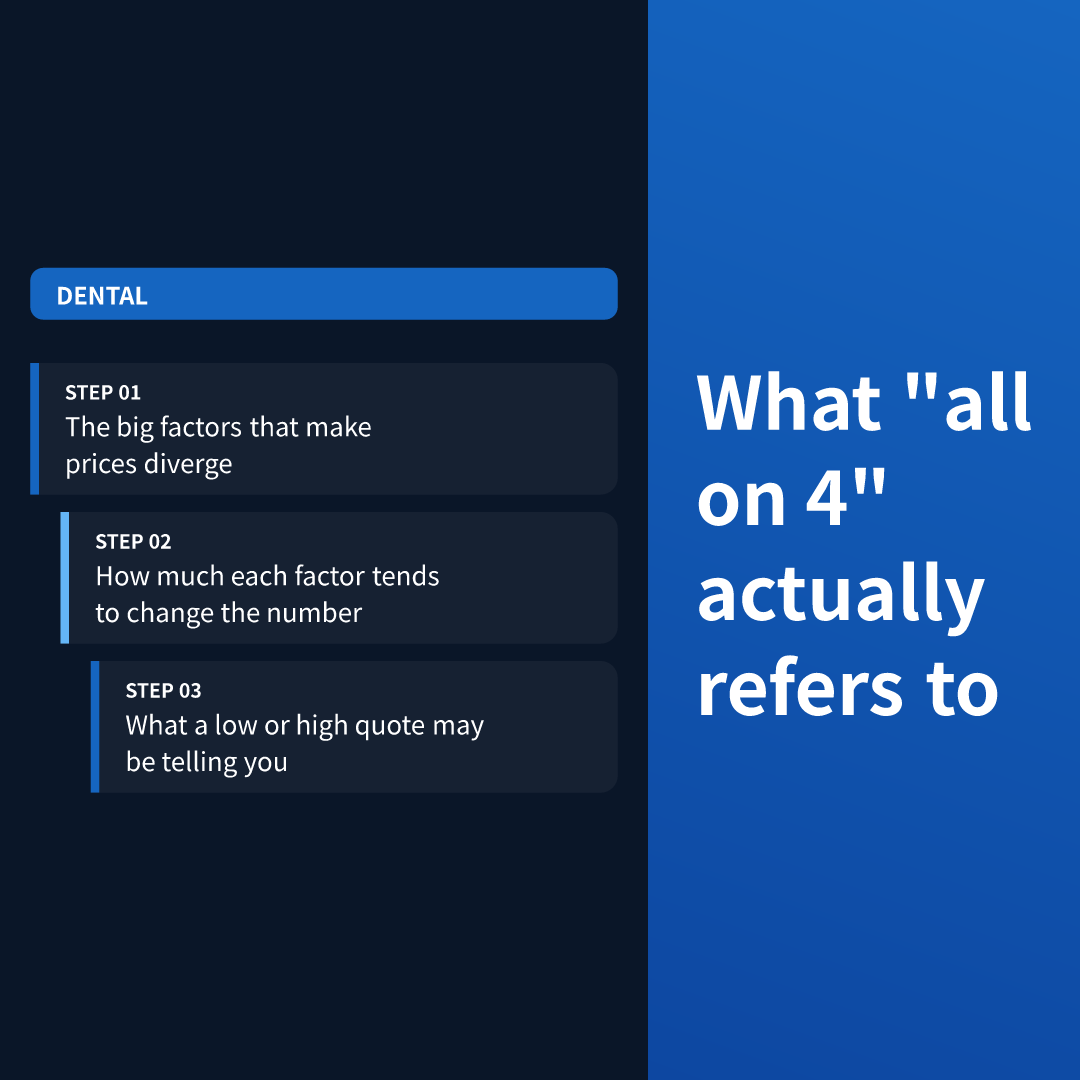
What "all on 4" actually refers to
All on 4 generally describes a way of supporting a full arch of replacement teeth on four implants placed in the jaw. The idea is that a small number of strategically positioned implants can hold a fixed bridge, rather than placing one implant per missing tooth. Many people hear the name and assume it is a single, standardized product, but clinics use the term in slightly different ways.
Some practices use it as a trademark-style label for a specific protocol, while others use it loosely for any full-arch fixed restoration on a small number of implants. Some plans use more than four implants when the bone or bite calls for it. That naming flexibility is one reason two quotes can describe quite different treatments.
The big factors that make prices diverge
Full-arch treatment is not one purchase. It is a chain of steps, and each link can be priced differently. The factors below usually account for most of the gap between quotes.
- Scope of the plan: One arch or both, and whether any teeth need to be removed first.
- Preparation work: Extractions, bone grafting, gum treatment, or sinus-related procedures when they are needed.
- Implant brand and components: Established systems with long records often cost more than lesser-known ones.
- Prosthesis material and design: The replacement teeth can be made from different materials, and the choice affects both price and feel.
- Imaging and planning: Three-dimensional scans, digital planning, and surgical guides add cost but may be built into the fee.
- Sedation or anesthesia: Often priced separately, depending on the type used.
- Clinician training and team: A surgeon and restorative dentist working together, or a specialist with extensive full-arch focus, may charge more.
- Location: Rent, labor, and local market conditions shift fees noticeably between cities and countries.
- Follow-up and maintenance: Whether aftercare, adjustments, and checkups are bundled in.
How much each factor tends to change the number
Not every factor moves the price equally. It helps to think in terms of "big levers" and "smaller levers" rather than trying to price each line item yourself.
The larger levers
The scope of treatment and the amount of preparation work are usually among the biggest drivers. A person who needs several extractions and bone augmentation before implants can be placed is looking at a different total than someone whose jaw is ready for surgery. Doing both arches roughly doubles the main components, though some clinics adjust pricing when both are treated together.
The prosthesis is another major piece. Temporary teeth placed on the day of surgery are often followed by a final set months later, and each stage may carry its own fee. Materials range from acrylic-based options to more durable, laboratory-intensive ceramics, and the dental laboratory's craftsmanship adds to the cost. General patient-information resources from the American Dental Association describe implant-supported restorations as multi-stage treatment, which is consistent with itemized pricing.
The smaller levers
Imaging, sedation, and individual component upgrades usually shift the total by smaller amounts, but they add up. A clinic that charges separately for scans, medications, and temporary teeth can look cheaper at first glance than one that bundles everything, even if the final totals end up close.
The hidden lever: your own situation
Your bone volume, gum health, bite, and general health all influence the plan, and the plan influences the price. The National Institute of Dental and Craniofacial Research notes in its general information on dental implants that overall health and oral conditions can affect whether implants are appropriate. This is why an online average rarely matches a personalized estimate, and why a proper examination comes before any reliable number.
What a low or high quote may be telling you
A big gap between quotes is not automatically a red flag, and a high number is not automatically a sign of quality. Price is one piece of information, and it is worth asking what sits behind it.
When a lower quote may reflect real differences
A lower figure can come from a region with lower overhead, a streamlined workflow, or a plan that uses simpler materials. It can also come from a quote that leaves things out. Common omissions include preparation procedures, sedation, the final prosthesis, or follow-up visits. If the lower quote covers fewer steps, comparing it with a bundled quote is not a fair match.
Some very low advertised prices describe only part of the process, such as the surgery or a temporary set of teeth. Ask whether the figure is for the entire treatment from consultation to final teeth.
When a higher quote may reflect real differences
A higher figure may include more thorough planning, a larger team, higher-grade components, a custom-made final prosthesis, and longer aftercare. It may also reflect a premium location or branding. Higher pricing does not guarantee better results, and results vary from person to person, so it is reasonable to ask the clinic to explain specifically what the extra cost covers.
Why the middle is not always the safe choice
It is tempting to pick the quote in the middle and call it a day. That approach can backfire, because the middle number may still be missing something the others include. A line-by-line comparison tells you far more than ranking totals.
Experience, follow-up, and the question of "what if something needs fixing"
Full-arch treatment is a long-term commitment, and complications, adjustments, or repairs can happen with any dental work. The American Academy of Periodontology and similar professional bodies generally emphasize that implants need ongoing cleaning and monitoring to stay healthy. That means maintenance is part of the real cost, even if it is not part of the surgery fee.
Ask how the clinic handles adjustments to the bite, repairs of the prosthesis, and problems with an implant that does not integrate as expected. Some practices include a defined period of follow-up care, while others bill each visit separately. Warranty-style policies vary a lot, and their terms, exclusions, and conditions matter more than the headline promise.
Related reading: Dental Implants for Missing Teeth: How to Read Your Treatment Plan
Financing, insurance, and other practical money questions
Dental insurance often covers only a portion of implant-related care, and some plans exclude implants entirely or apply annual limits. Coverage differs between plans, so it is worth asking both the clinic and your insurer what applies to your situation. Some parts, such as extractions or certain preparatory procedures, may be treated differently from the implants themselves.
Many clinics offer payment plans or work with third-party financing. Terms, interest, and fees vary, so read the agreement carefully and consider whether the monthly figure fits your budget over the long term. Health savings or flexible spending accounts may be usable for some dental costs depending on your plan, which a benefits administrator or tax professional can clarify.
If you are considering treatment abroad to lower the price, factor in travel, time away, and the practical challenge of follow-up care if something needs attention after you return home. These are personal trade-offs rather than simple right or wrong answers.
Who may need extra caution or a different plan
All on 4 is not suitable for everyone. Conditions such as uncontrolled diabetes, heavy smoking, certain medications, gum disease that has not been treated, and limited jawbone can affect planning and outcomes. The National Institute of Dental and Craniofacial Research and other public health bodies describe these as factors a dental team considers when evaluating implants.
If a clinic proposes the treatment without examining your mouth, reviewing imaging, or asking about your medical history, that is worth pausing over. Being told you are an ideal candidate before any assessment is not a reliable basis for a decision. A second opinion from a different practice is a common and reasonable step for a procedure of this size.
What to check when you read an estimate
A good estimate is one you can read line by line and understand. Before comparing totals, make sure each quote describes the same scope of work. Use the checklist below as a starting point when you sit down with the paperwork.
- Does the quote cover one arch or both, and is that stated clearly?
- Are extractions, bone grafting, and other preparation steps included or listed separately?
- How many implants are planned, and what brand and components will be used?
- What material is the final prosthesis made from, and who makes it?
- Are temporary teeth included, and is the final set priced separately?
- Are scans, planning, sedation, and medications included?
- What follow-up visits, adjustments, and cleanings are covered, and for how long?
- What happens if an implant fails or the prosthesis needs repair, and what does the written policy say?
- Who performs the surgery and who completes the restoration, and what is their training in full-arch care?
- What are the payment terms, deposits, and refund conditions if you change your mind?
- Has an examination and imaging been done before the figure was given?
- Can the clinic put the full plan and cost in writing so you can compare it with a second opinion?
Put each quote beside the others and mark what is missing from each. The cheapest-looking option may be the most incomplete, and the most expensive may simply be the most itemized. Understanding all on 4 dental implants cost comes down to comparing like with like, and a qualified dental professional who has examined your mouth is the right person to confirm what your own plan should include.
Disclaimer: This article is for informational purposes only and is not a substitute for professional medical advice, diagnosis, or treatment. Please consult a licensed professional for personal health decisions.