Root Canal Filling Material Types, Explained Simply
Root canal filling material types refer to the different substances a dentist or endodontist uses to seal the inside of a tooth’s root canal system after the infected or damaged pulp tissue has been removed. The most common material is a rubber-like compound called gutta-percha, usually paired with a sealer paste that fills tiny gaps. By the end of this article, you’ll understand what these materials actually do, how they’re chosen, and how they differ from the fillings people use to patch cavities.
What “Filling Material” Actually Means Inside a Root Canal
When people hear “root canal filling,” many picture the same kind of filling used for a cavity—but it’s a different thing entirely. A cavity filling sits on the visible, chewing surface of a tooth. Root canal filling material, on the other hand, is packed deep inside the narrow, hollow canals that run through a tooth’s root, in the space where the nerve and blood vessels used to be.
According to general dental references, the goal of this internal filling is to seal off that empty canal space completely, so bacteria can’t move back in and cause a new infection. Think of the root canal system like the plumbing inside a wall: once you’ve cleaned out a clogged pipe, you don’t leave it open—you seal it shut so nothing leaks back through. That’s roughly what canal filling material is doing, just on a much smaller scale.
Gutta-Percha: The Standard Core Material
Gutta-percha is a natural, rubber-like material derived from certain tree latex, and it has been the primary filling material used inside root canals for a very long time. It’s typically shaped into thin, tapered cones or points that are inserted into the cleaned canal space and compacted to fill the shape of the root.
One reason it’s stayed popular is that it’s relatively inert, meaning it doesn’t tend to react much with surrounding tissue, and it can be softened with heat or pressure to adapt closely to the curves of a root canal. It’s rarely used entirely on its own, though—it’s almost always combined with a sealer.
Root Canal Sealers
Sealers are pastes or cements that fill in the microscopic spaces between the gutta-percha and the walls of the canal. Without a sealer, gutta-percha alone wouldn’t create a watertight, bacteria-tight seal, because canal walls are rarely perfectly smooth or uniform in shape.
There are several categories of sealers in general use, including:
- Zinc oxide-eugenol based sealers — one of the older, longer-established types
- Resin-based sealers — designed to bond more closely with canal walls
- Bioceramic sealers — a newer category that some dentists prefer for certain cases because of how they interact with tooth structure
- Calcium hydroxide-based sealers — sometimes used for their tissue-friendly properties
Which sealer a dentist chooses often depends on their training, the specific case, and the equipment or technique they’re comfortable with—there isn’t one single sealer that’s considered correct for every situation.
When Different Root Canal Materials Come Into Play
Root canal filling materials are used only after the earlier steps of a root canal procedure are finished—meaning the infected or inflamed pulp has been removed and the canal has been cleaned and shaped. The filling stage is essentially the final internal step before the tooth is restored on top, often with a crown or a filling that closes the access hole.
In some cases, especially where a canal is unusually wide, short, or shaped irregularly, a dentist may choose a different filling approach, such as using a carrier-based system where gutta-percha is coated onto a firm core, or using bioceramic materials that set into a harder, more solid consistency. The decision tends to be based on the anatomy of that particular tooth, not on a fixed rule that applies to every patient.
Related reading: How Long Does Root Canal Take to Fully Recover?
Why Material Choice Isn’t One-Size-Fits-All
A molar with several curved, narrow canals may call for a more flexible filling technique than a single straight canal in a front tooth. Similarly, a tooth being treated a second time—after a previous root canal has failed—may need a material that’s easier to remove later if further treatment is ever needed. This is one of the reasons a general dentist may sometimes refer a more complex case to an endodontist, a dentist who specializes in root canal treatment specifically.
How This Differs From Cavity Fillings and Crown Materials
It’s a very common mix-up: people assume “filling” always means the same silver or white material used to patch a cavity. But cavity fillings—made from materials like composite resin or amalgam—are placed in the visible part of a tooth to restore its outer shape and chewing surface. Root canal filling material is placed deep inside the root, invisible from the outside, and it doesn’t need to bear chewing pressure directly the way a surface filling does.
Another point of confusion is between the root canal filling and the final restoration that goes over it. After the canal is filled, the access opening on top of the tooth is usually closed with a temporary or permanent filling, and often a crown is placed afterward to protect the weakened tooth structure. These are separate materials serving separate purposes, even though they’re part of the same overall treatment.
Temporary vs. Permanent Canal Fillings
In some multi-visit treatments, a dentist may place a temporary filling material inside the canal or access area between appointments, particularly if there’s ongoing drainage or infection that needs monitoring. This is different from the final, permanent filling material that seals the canal once treatment is complete. Mixing these up is common among patients who’ve had a root canal done over more than one visit and aren’t sure what’s happened at each stage.
Why the Type of Material Used Actually Matters
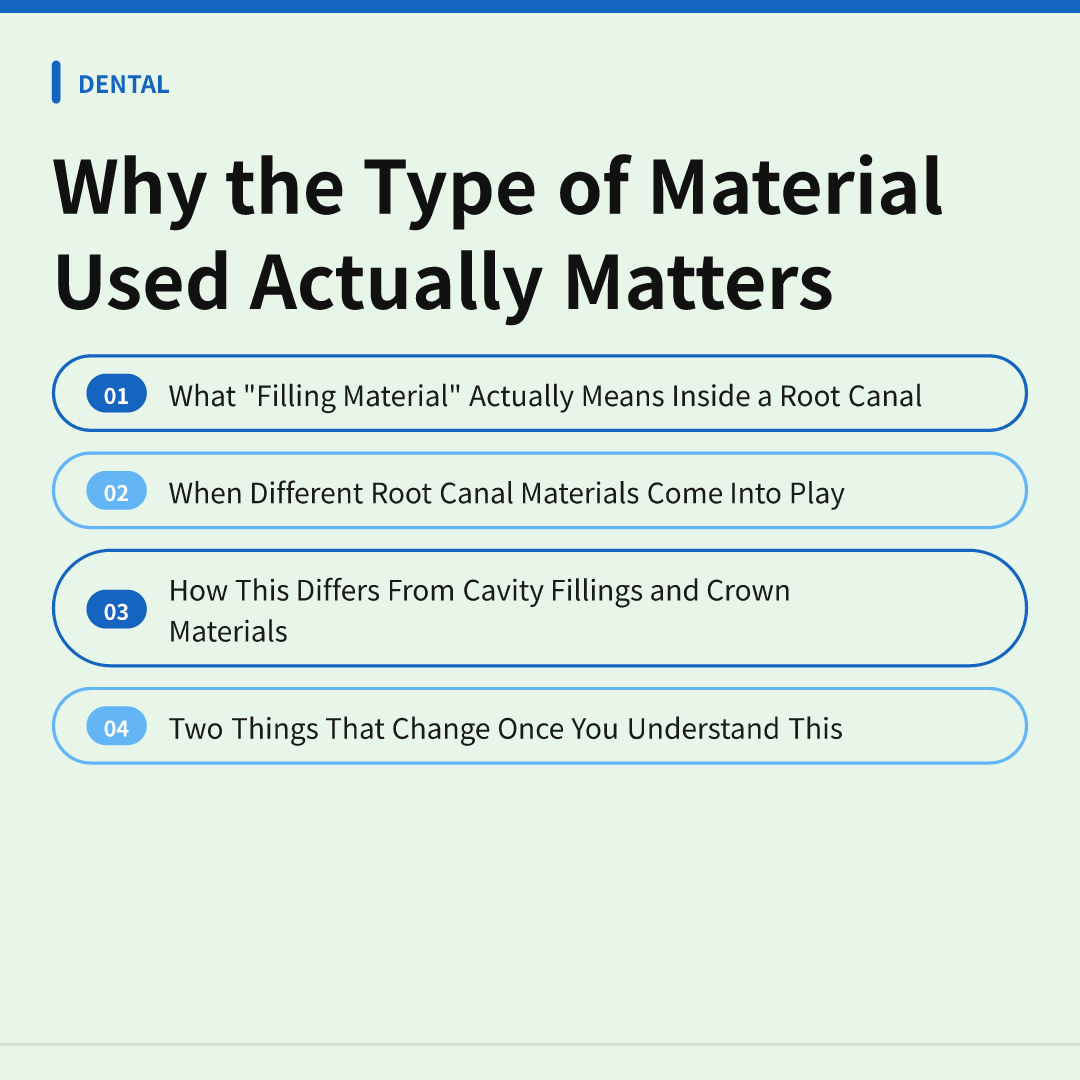
The material and technique used to fill a root canal can influence how well the canal is sealed, and a poor seal is one of the factors that can contribute to reinfection over time. That said, outcomes also depend heavily on how thoroughly the canal was cleaned and shaped beforehand, the tooth’s own anatomy, and how well the final restoration on top protects the tooth from new bacteria getting in. Material choice is one piece of a larger picture, not the only factor that determines whether a root canal holds up long-term.
Some people ask whether newer materials like bioceramic sealers produce better long-term results than traditional gutta-percha and zinc oxide-eugenol combinations. Evidence in this area is still developing, and it’s reasonable to ask your dentist what they use and why, rather than assuming one material is universally superior.
Related reading: Root Canal Tooth Sensitivity After Treatment: What’s Actually Going On
When to Bring This Up With Your Dentist
If you’re scheduled for a root canal, it’s fair to ask which filling material and technique will be used, especially if you have a complex tooth anatomy, a history of allergies, or a previous root canal that didn’t fully resolve. If you notice ongoing pain, swelling, or sensitivity weeks or months after a root canal, that’s a reason to follow up with your dentist rather than assume it will resolve on its own—it could point to an incomplete seal or a new source of infection that needs evaluation.
Related reading: Signs You Need a Root Canal: What to Watch For
Two Things That Change Once You Understand This
First, you’ll stop conflating a root canal filling with a cavity filling—they’re different materials, in different places, doing different jobs, and confusing them can lead to unnecessary worry or wrong expectations about what a dentist is actually doing. Second, you’ll know that asking about material choice isn’t overstepping; it’s a reasonable question, and a dentist’s answer about why they chose gutta-percha with a particular sealer, or a bioceramic-based approach, can help you understand your own treatment plan a little better. Root canal filling material types aren’t a one-size-fits-all decision, and knowing that gives you a more grounded way to evaluate your own care.
Disclaimer: This article is for informational purposes only and is not a substitute for professional medical advice, diagnosis, or treatment. Please consult a licensed professional for personal health decisions.