Women Hair Loss Treatment Options: Why the Causes Differ So Much
A wider part, a thinner ponytail, more strands in the shower drain: these are the changes that send many women searching for women hair loss treatment options. The reason these changes happen is rarely a single thing. Hair grows in cycles, and anything that disrupts those cycles, from hormones to nutrition to stress on the body, can show up as shedding or thinning. Understanding that chain of cause and mechanism makes the range of approaches easier to make sense of.
This article follows that chain step by step, from what you can see, to the common triggers, to the biology underneath, to why two women with similar-looking hair loss can have very different stories. It is general information, not a way to diagnose yourself.
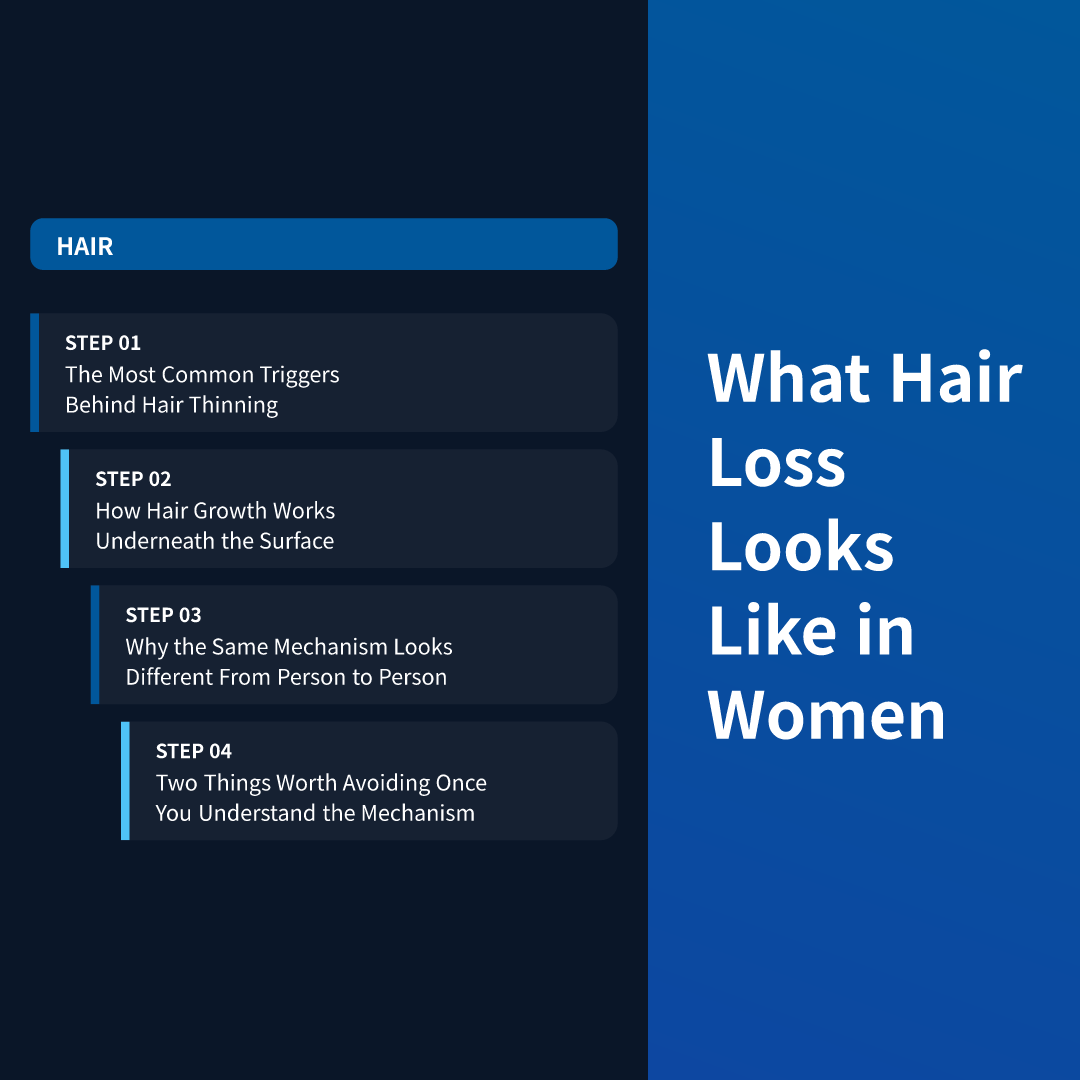
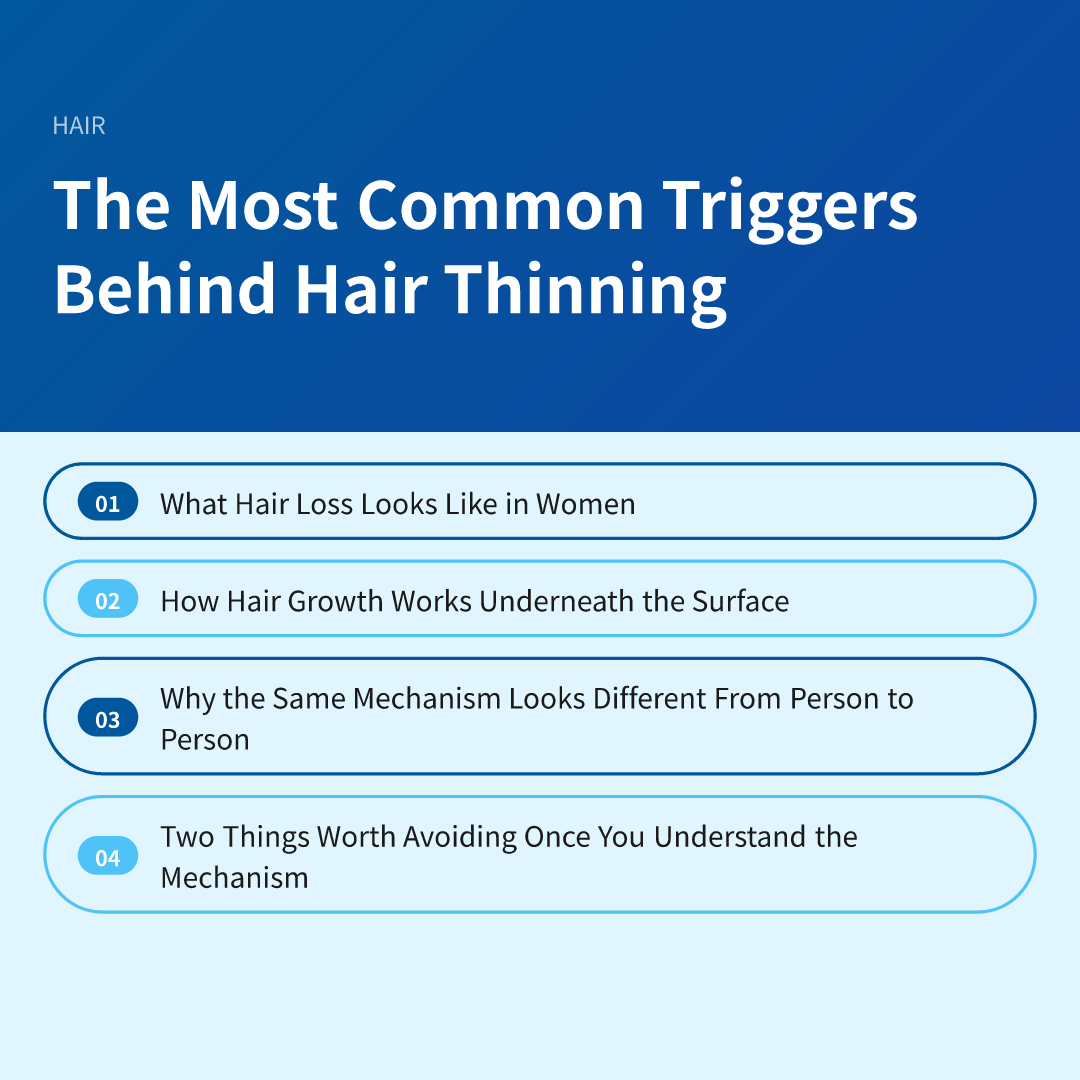
What Hair Loss Looks Like in Women
Hair loss in women does not always look like the receding hairline or bald patch that many people picture. More often it is gradual and diffuse. A part line may widen over time, the scalp may become easier to see under bright light, or a ponytail may feel noticeably thinner than it used to.
Other women notice something different: sudden heavy shedding that seems to come out of nowhere, or small round patches where hair is missing entirely. Some notice breakage along the hair shaft rather than loss from the root, which is a separate issue tied to styling, chemical processing, or hair fragility.
Shedding, thinning, and patches are not the same thing
These patterns often point toward different underlying processes. Widespread shedding that begins a few months after a major event is commonly described differently from slow thinning at the crown or part. Sharply defined bald spots are usually grouped separately again. According to the American Academy of Dermatology, hair loss has many possible causes, which is why the pattern you notice matters when you talk with a professional.
Normal shedding versus a real change
Everyone loses hair daily as part of the normal growth cycle. The concern usually begins when the amount, speed, or pattern changes from your own baseline, or when the scalp looks different. Because daily shedding varies naturally, it is the change over weeks and months that tends to be more informative than any single day.
The Most Common Triggers Behind Hair Thinning
Several categories of triggers come up repeatedly in general health references. The MedlinePlus overview of hair loss lists factors such as family history, hormonal changes, medical conditions, medications, and physical or emotional stress, among others.
- Hormonal shifts: pregnancy and the postpartum period, menopause, and conditions that affect hormone balance are often discussed in connection with hair changes.
- Inherited pattern thinning: a genetic tendency toward gradual thinning, sometimes called female pattern hair loss.
- Physical stressors: significant illness, surgery, rapid weight change, or a high fever can be followed by noticeable shedding some time later.
- Nutritional gaps: low iron or insufficient overall intake are commonly mentioned as possible contributors, though they are not the cause for everyone.
- Thyroid and other medical conditions: thyroid imbalance and certain autoimmune conditions can affect hair.
- Medications and treatments: some prescription drugs and cancer therapies are known to affect hair growth.
- Hair care habits: tight hairstyles worn for long periods, heat, and harsh chemical processing can damage hair or irritate follicles.
It is common for more than one of these to overlap. A woman with a family tendency toward thinning may notice it more after a stressful illness, for example, because the two processes stack together.
How Hair Growth Works Underneath the Surface
To see why these triggers matter, it helps to know how a hair follicle behaves. Each follicle cycles through phases: an active growth phase, a short transition phase, and a resting phase before the hair sheds and the cycle begins again. At any moment, most hairs on a healthy scalp are in the growth phase, while a smaller share are resting.
A simple cause-and-effect chain
Many forms of hair loss can be described as a chain of events. Here is a general way to picture it:
- A trigger occurs, such as a hormonal change, illness, or inherited sensitivity.
- The follicle receives a signal that changes its normal rhythm.
- More hairs than usual move into the resting phase, or the growth phase becomes shorter.
- Hairs shed earlier, and replacement hairs may grow back finer or more slowly.
- Over time, the overall density looks lower.
This helps explain the delay that so many women find confusing. Because hairs rest before they shed, noticeable shedding often appears well after the triggering event, which can make the connection hard to spot.
Follicle miniaturization in pattern thinning
In inherited pattern thinning, the commonly described mechanism is different. Follicles in affected areas gradually become smaller and produce shorter, finer hairs with each cycle. Hormone sensitivity in the follicle is generally discussed as part of this process. The change is slow, which is why it often goes unnoticed until the scalp becomes more visible.
When the immune system or scarring is involved
In some conditions, the immune system targets follicles, producing patchy loss. In others, inflammation can permanently damage follicles, which is generally called scarring alopecia. These are less common than the other patterns, but they matter because early evaluation may influence what options remain. The American Academy of Dermatology notes that some hair loss involves scarring, and that timely assessment by a dermatologist can be important.
Why the Same Mechanism Looks Different From Person to Person
Two women can share a trigger and still have very different outcomes. Genetics influence how sensitive follicles are to hormonal signals. Age matters, since hair density and growth patterns shift over a lifetime. Overall health, other medications, and the amount of time a trigger lasts all play a role.
Hair type and styling history add another layer. Fine hair can make thinning look more obvious, while thick or curly hair may hide early changes. Scalp conditions, such as persistent irritation or flaking, can further complicate the picture.
Why one approach does not fit everyone
Because the underlying cause varies, there is no single answer among women hair loss treatment options. General references describe a range of approaches that a clinician may discuss depending on the cause: reviewing and addressing underlying medical issues, evaluating nutrition and lab work, discussing topical or prescription products, considering in-office procedures, or using cosmetic options such as hair fibers, styling changes, or wigs. Whether any of these is appropriate depends on the diagnosis, other health conditions, pregnancy plans, and personal preferences.
Some products are sold over the counter and others require a prescription. Some are not suitable during pregnancy or while trying to conceive, so decisions about use are best made with a pharmacist or doctor rather than based on general information alone. Results vary, and improvement, when it happens, is usually gradual rather than quick.
Related reading: Hair Loss Due to Stress: Solutions That Make Sense
When to seek professional care
It is reasonable to consider seeing a primary care clinician or dermatologist if any of the following apply:
- Hair loss is sudden, patchy, or rapidly progressing.
- The scalp is painful, red, scaly, or itchy.
- Hair loss comes with fatigue, weight change, irregular periods, or other new symptoms.
- It began after starting a new medication.
- It is affecting your mood or daily confidence.
A professional can examine the scalp, ask about history, and decide whether tests are needed. Getting a clearer picture of the cause generally makes it easier to weigh your options realistically.
Two Things Worth Avoiding Once You Understand the Mechanism
Knowing that hair loss usually follows a chain from trigger to follicle response points to two habits that tend to work against women.
First, avoid guessing at the cause and starting products on your own. Since different mechanisms call for different approaches, an unneeded or mismatched product can cost money and time while the real cause goes unaddressed. Supplements deserve particular care, because taking more of a nutrient than the body needs is not necessarily helpful, and some can interfere with lab tests or medications. Ask a pharmacist or doctor before using any product.
Second, avoid waiting and worrying in silence, or judging results too early. Because the hair cycle is slow, changes in shedding take months to show, and expecting quick results can lead to abandoning a reasonable plan or chasing the next promise. At the same time, ignoring sudden or patchy loss can delay evaluation of something that needs attention. Keeping a simple record of when changes began and bringing it to an appointment is usually more useful than either extreme.
Disclaimer: This article is for informational purposes only and is not a substitute for professional medical advice, diagnosis, or treatment. Please consult a licensed professional for personal health decisions.