Finasteride Generic vs Brand Name: Why There’s No Universal Winner
A lot of people assume the finasteride generic vs brand name question has a clean answer — that one option is simply smarter, cheaper, or safer across the board. In practice, that assumption falls apart the moment you look at two different people with two different medical histories, budgets, and insurance plans. The same active ingredient can lead two reasonable people to two completely different, equally defensible choices.
Instead of declaring a winner, it helps to look at the conditions under which each version tends to make more sense, where the two options are functionally identical no matter what, and what to watch for if you ever switch from one to the other. None of this substitutes for a conversation with a licensed prescriber, but it should help that conversation go further.
Why a Side-by-Side Comparison Rarely Tells the Whole Story
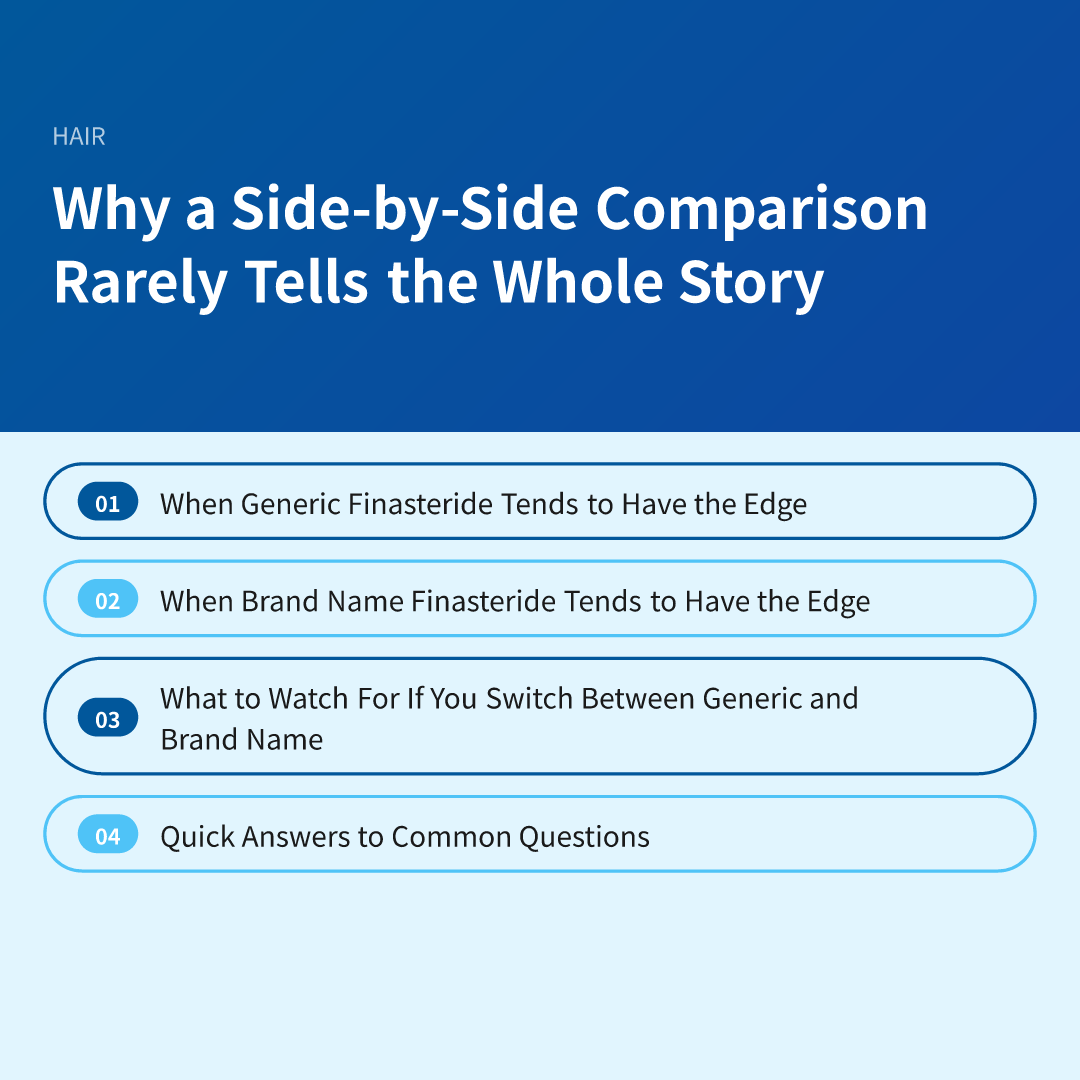
Most comparisons treat generic and brand name finasteride as if they exist in a vacuum — same drug, so just pick whichever is cheaper. That logic holds up reasonably well for some people and falls apart for others, because it ignores variables that don’t show up in a simple price chart: insurance structure, personal history with inactive ingredients, and how sensitive someone’s routine is to any change in appearance, texture, or packaging of a tablet.
The active compound in both versions is regulated to the same standard. According to the U.S. Food and Drug Administration’s overview of generic drugs, generics must contain the same active ingredient, strength, and dosage form as their brand name counterparts, and must meet equivalent quality and performance standards before approval. That’s exactly why a comparison stripped of personal context misses the point — the meaningful differences live in the inactive ingredients, the price after insurance, and the person taking the medication, not in the active compound itself.
When Generic Finasteride Tends to Have the Edge
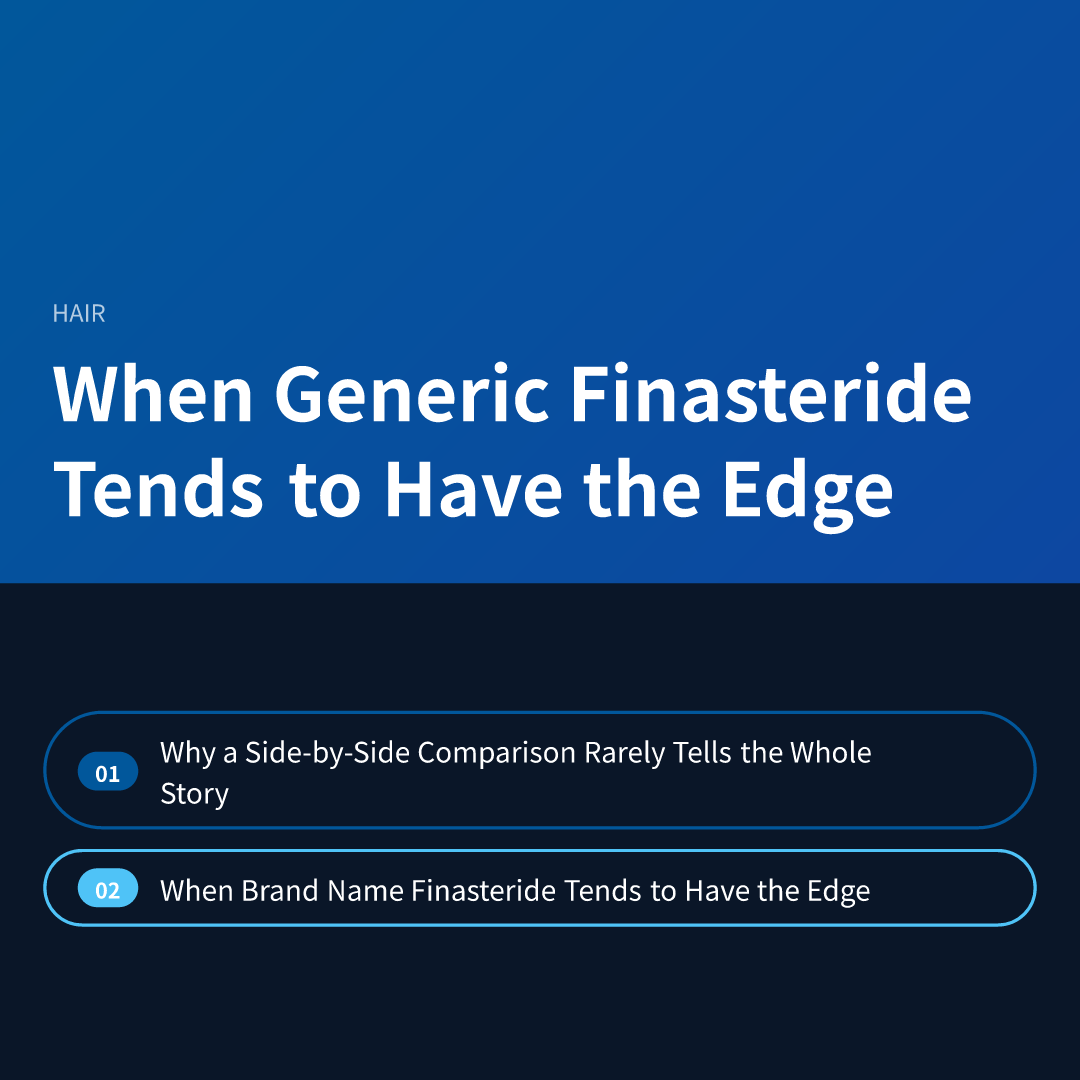
Picture someone in his mid-twenties, still finishing a degree, working part-time, and noticing early thinning at the crown. Every recurring expense in his budget gets scrutinized before he commits to it. For someone in this position, cost isn’t a minor detail — it’s frequently the difference between a medication that gets used consistently for months or years and one that quietly gets abandoned after a few weeks because the monthly bill feels unsustainable.
Generic finasteride typically costs less than the brand name version, largely because generic manufacturers don’t carry the same development and marketing overhead. For someone with no documented sensitivity to specific fillers or dyes, and no history of unusual reactions to other generic medications, there’s generally little reason to pay a premium for the brand name product — the active compound doing the work is considered equivalent under regulatory standards regardless of manufacturer.
If cost is the main obstacle standing between you and consistent use, and you have no known sensitivities to specific inactive ingredients, generic finasteride is often a reasonable starting point to raise with a prescriber.
Since hair loss treatments generally need consistent use over an extended period to have any chance of maintaining results, affordability plays a real role in whether a medication ever gets a fair trial in the first place — not just a side note to the decision.
Related reading: Hair Loss Stress Management Techniques That Actually Help
When Brand Name Finasteride Tends to Have the Edge
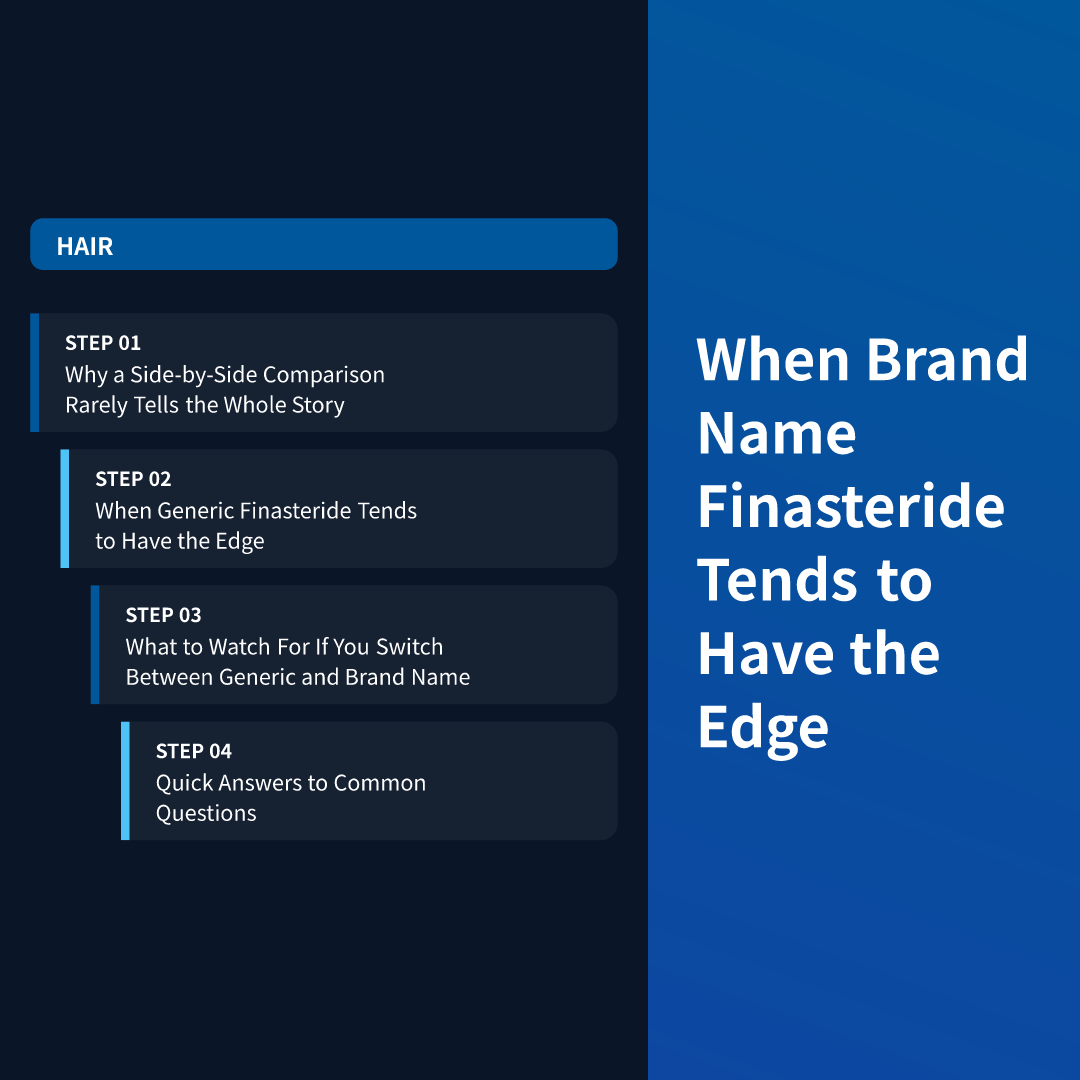
Now picture someone in his mid-forties who has taken various medications over the years and noticed that generic versions of certain drugs sometimes affect him differently — maybe mild stomach upset, or a skin reaction he suspects was tied to a specific filler or dye. He also values predictability: the same pharmacy, the same packaging, the same manufacturer, month after month.
Inactive ingredients — the fillers, dyes, coatings, and binders that hold a tablet together — can differ between the brand name product and various generic manufacturers, and even between different generic manufacturers themselves. For most people that difference is unnoticeable, but for someone with a personal history of sensitivity to specific inactive ingredients, that variability can matter more than it would for someone without that history.
Insurance coverage can also flip the equation. If employer-provided coverage makes the brand name copay comparable to what a generic would cost out of pocket, much of the practical cost advantage of choosing generic disappears — and other factors, like sticking with a formulation that has never caused a problem, can reasonably take priority. There’s also a psychological layer worth naming honestly: some people simply feel more confident sticking with a familiar, single-manufacturer product after years of trial and error with other medications. That’s not a scientific case for brand superiority, but personal comfort affects adherence, and a treatment only works if someone actually keeps taking it as directed.
What to Watch For If You Switch Between Generic and Brand Name
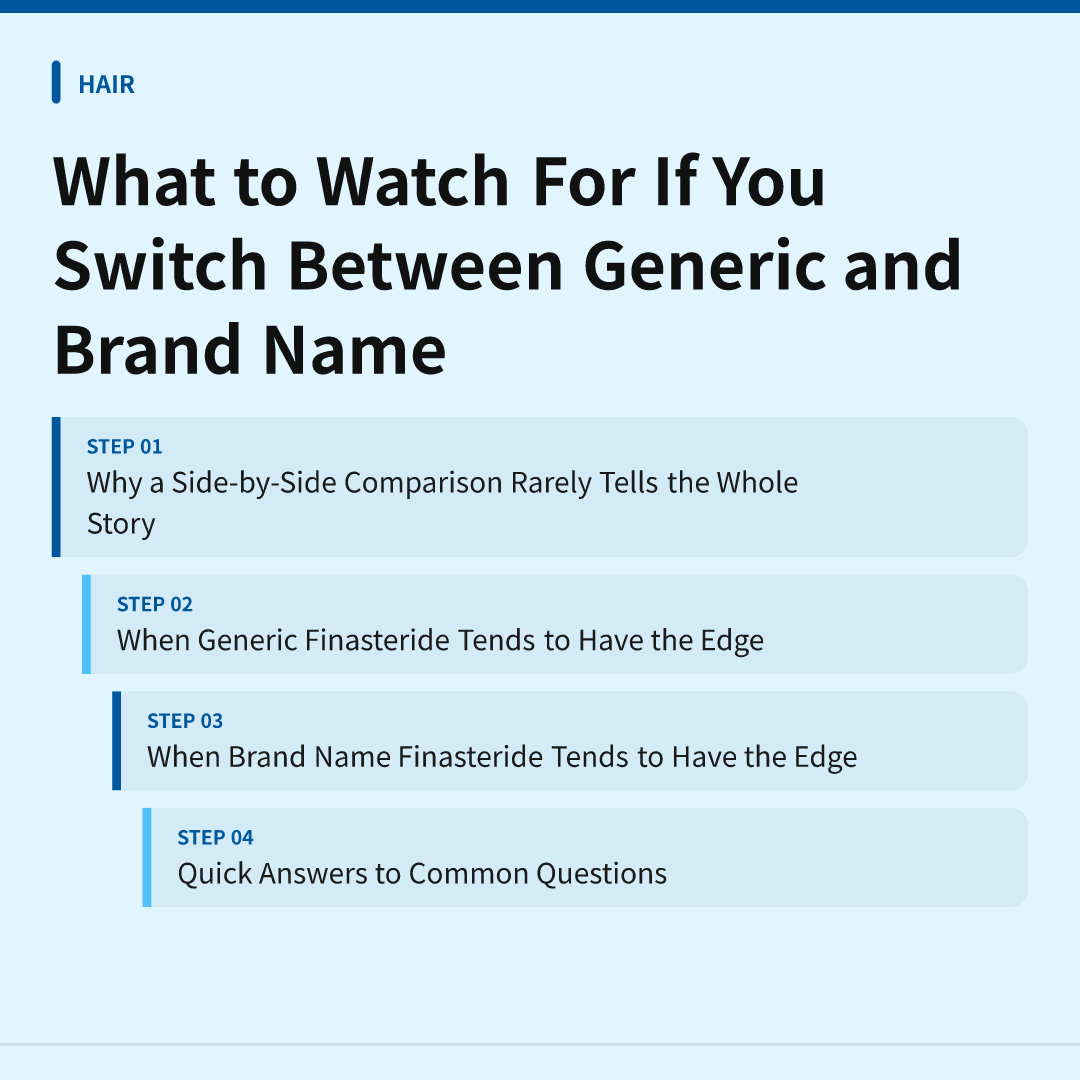
Whether someone starts on generic or brand name, a few things don’t change, and it’s worth being clear-eyed about them before assuming a switch will feel completely uneventful.
- Both still require a prescription. Finasteride for hair loss isn’t available over the counter, and a licensed prescriber needs to evaluate whether it fits your medical history and goals before or after a switch.
- Warnings and precautions stay identical. Since the active ingredient is the same, potential side effects and populations who should avoid the medication (such as pregnant individuals, per manufacturer labeling) don’t change based on brand versus generic.
- Individual response can shift with any change. Some people notice nothing different after switching formulations; others notice a reaction that has more to do with a specific filler than with finasteride itself, which is worth mentioning to a prescriber rather than assuming it’s the drug failing.
- Sourcing matters more than the label. A tablet obtained from an unlicensed or unverified source carries risks that have nothing to do with the finasteride generic vs brand name debate — it comes down to whether the product is legitimate at all.
- Follow-up still matters. Periodic check-ins with a prescriber are generally advised after any switch, so side effects or a lack of expected results can be caught and adjusted early.
It’s also worth remembering that hair loss has multiple possible causes, and finasteride isn’t appropriate or effective for every pattern of thinning. If you notice new or worsening symptoms after switching versions — mood changes, sexual side effects, breast tenderness, or anything else that concerns you — that’s reason enough to contact your prescriber promptly rather than waiting to see if it resolves on its own.
Related reading: Hair Loss From Dandruff and Itching: What’s Really Happening on Your Scalp
Quick Answers to Common Questions
Is brand name finasteride actually stronger or more effective than generic?
No. Both contain the same active ingredient at the same strength, and generics must meet the same quality and performance standards before approval. Any difference in personal experience usually traces back to inactive ingredients or individual response, not the strength of the active compound.
Can I switch from brand name to generic finasteride without any problems?
Most people switch without noticing any difference. A small number notice a reaction tied to a specific inactive ingredient rather than the finasteride itself, which is worth flagging to a prescriber so it can be addressed rather than assumed to be a treatment failure.
Does insurance always make generic finasteride cheaper?
Not always. Coverage structures vary enough that some people find the brand name copay comparable to the generic’s out-of-pocket cost, which changes the practical calculation considerably. It’s worth checking your specific plan rather than assuming generic is automatically less expensive in every case.
What should I ask a prescriber before choosing between generic and brand name finasteride?
It helps to ask directly: does my medical history include any documented sensitivity to specific inactive ingredients, does my insurance change the real-world price gap between the two options, and is there a reason — medical or otherwise — to prefer one formulation’s consistency over the other? Bringing those specific questions to the appointment usually leads to a clearer, more personalized answer than reading general information alone.
Disclaimer: This article is for informational purposes only and is not a substitute for professional medical advice, diagnosis, or treatment. Please consult a licensed professional for personal health decisions.